What Are Jefferson Clocks Made Of?
By Roger Russell
These
pages are copyrighted
No portion of this site may be reproduced in whole or in part
without written permission of the author.
 The main pieces of many of the Jefferson clocks are
made of cast metal. Because of the color and weight, the material could be
thought of as brass. Brass is known to be non-magnetic and a magnet placed on
the base of a Golden Hour clock is not attracted. However, it seems to be
attracted to the cast outer ring assembly.
The main pieces of many of the Jefferson clocks are
made of cast metal. Because of the color and weight, the material could be
thought of as brass. Brass is known to be non-magnetic and a magnet placed on
the base of a Golden Hour clock is not attracted. However, it seems to be
attracted to the cast outer ring assembly.
The truth is that the retainer ring at the rear and the gear ring inside are made of steel. Once they are removed, the magnet is no longer attracted to the outer ring. There's more to the story, however, and there are other metals besides brass that are non- magnetic.
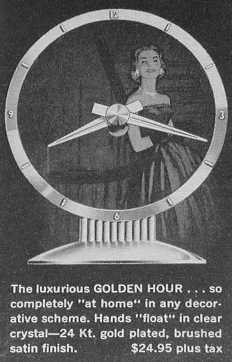
The Golden Hour and some other models are 24 karat gold plated. Here's an ad from the December 8, 1956 issue of the New Yorker magazine. This and many other ads over the years advertise 24 karat gold plating. This is why the clock is called "Golden Hour." Several other Jefferson clocks are also gold plated. See my Gold Reference Page for more information about gold and karat ratings.
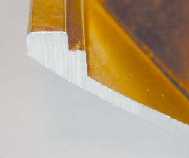 The main parts are not made of brass. The base and
frame are made of a less expensive alloy casting. A cross section of this
Golden Hour base shows the material to be silver colored.
The main parts are not made of brass. The base and
frame are made of a less expensive alloy casting. A cross section of this
Golden Hour base shows the material to be silver colored.
I sent a sample of the base from a 1961 Golden Hour to a highly qualified testing laboratory: Bodycote Taussig, Inc., 7530 Frontage Road, Skokie, IL 60077. They identified the metal as a common zinc alloy 3 per ASTM B86-97.
INTERZINC refers to this as a traditional zinc alloy known as Zamak #3. It was originally developed in the 1930's and aluminum is the major alloying element at a nominal 4 percent. There's a small amount of magnesium and copper. Adding aluminum to zinc increases castability and results in finer grain size castings and improved mechanical properties. Magnesium is added to improve strength and hardness and to protect castings from inter-granular corrosion. Copper further strengthens and improves wear resistance of castings but at the expense of stability (dimensional property), especially when copper content exceeds 1 percent.
|
Zinc Alloy Chemistry Zamak #3 |
Golden Hour Sample |
|
|
aluminum |
3.5 to 4.5% |
4.05% |
|
|
|
|
An interesting feature about the gold plating process is the need for first plating the zinc casting with nickel. This provides better adhesion for the gold plating. In addition, a bright nickel plate will give a high level of luster to the gold plated finish. If the gold finish is removed from the Golden Hour base and ring, the nickel finish will be exposed.
Of course, the problem occurs when owners think the clock is brass and go about trying to polish the clock with brass cleaner or even coarser material to bring the shine of the "brass" out. The thin gold plating is then inadvertently worn through and the finish is ruined. The only solution is to then have the base and ring replated.
The hand assembly is made of brass. The gold plated retaining ring, gear ring, three small leaf springs and, of course, the motor are made of steel.
A similar test made on a Haddon Golden Vision
clock yielded similar information
The casting is also a zinc alloy,
Zamak #3.

Two Different Base Castings Have Been Found
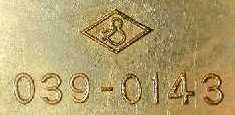
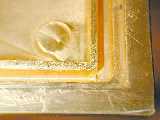
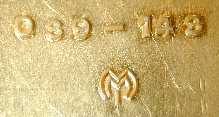
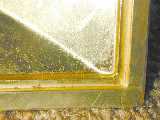
The base casting part number and symbol can be found under the motor.
In several Jefferson advertisements the clear portion of the dial is referred to as “crystal” instead of glass. Perhaps saying crystal is nicer than just saying plain glass or window glass. So what is crystal glass anyway? True crystal glass has a high refractive index, making the look of glassware more brilliant and capable of exhibiting the rainbow light spectrum when placed in sunlight. Crystal is made by combining silica with lead oxide enabling the glass walls to be made thinner. It also has the quality of “ringing” (resonating) when tapped with a finger. This is easily heard with glassware, bowls, goblets, etc. Crystal has been used in demonstrations where the sound wave of a single note tuned to the resonant frequency of a thin-walled drinking glass can shatter it. The resonating feature has also been used in making musical instruments. One such instrument is called the Armonica invented by Benjamin Franklin. In comparison, common window glass contains no lead and does not exhibit these traits. The following quote is from Swarovski Strass Manufacturing.
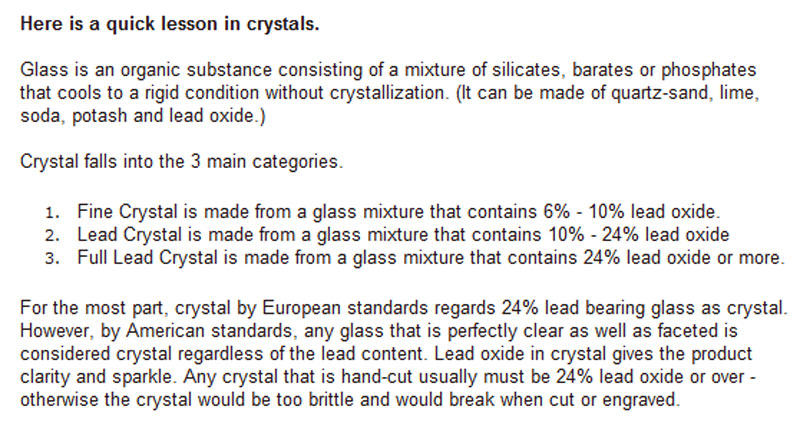
A flat disc such as those used in some Jefferson clocks has no facets and does not qualify as crystal according to Swarovski. Even cutting the center hole in crystal could to cause it to break or shatter more easily. The lead produces greater clarity and does not add coloration to the glass. The question remains about the truth of the statement that it is really clear crystal or just ordinary window glass.
Clear Lucite and clear crystal are optically superior when it comes to color transmission. You have all heard the expression that things are “crystal clear.” To make a comparison, I have taken a picture of a glass disc removed from a Jefferson Golden Hour and a clear Lucite disc of the same diameter and thickness. I have shown the edges because it illustrates the difference better. The Lucite is placed on top of the glass. The edge of the Lucite is not polished after it was cut to size and is hard to see against a white background.
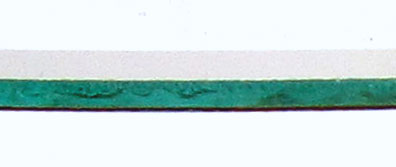
The glass has a very definite green color that is found in ordinary window glass. However, the Lucite above it has no color. Of course, the green color is not as apparent when looking directly through each of them. The green color is due to the presence of iron and is found in common window glass but not found in clear Lucite or clear crystal. So the Golden Hour and perhaps the other Jefferson mystery clocks, except for the Plexiglas disc in the Suspense clock, were made with ordinary window glass and not “clear crystal” mentioned in the Jefferson literature. Typical Jefferson literature for the Golden Hour is shown at the beginning of this page.
Complete instructions are furnished with pictures for glass restoration using new glass discs or Lucite replacement discs. They can also be used to reattach the original glass that has become detached from the outer gear ring, making the clocks appear to run faster.
An interesting side note is that today, low iron glass is available that has greater clarity. However, it was not introduced until the mid 1980’s. Jefferson Golden Hours were introduced in December 1949 and sold until 1991 when the clock division was closed. I have found that low iron glass is not available in the required thickness of 3/32 inches used in the Golden Hours.