Sonotone Phonograph Cartridge History
By Roger Russell
These
pages are copyrighted
No portion of this site may be reproduced in whole or in part
without written permission of the author.
Perhaps the best known Sonotone hi-fi products were the ceramic crystal and phonograph cartridges sold in the late 40's to the early 60's. Many were supplied by the hundreds of thousands to OEM manufacturers, such as Motorola, Voice of Music, Wurlitzer and Symphonic.
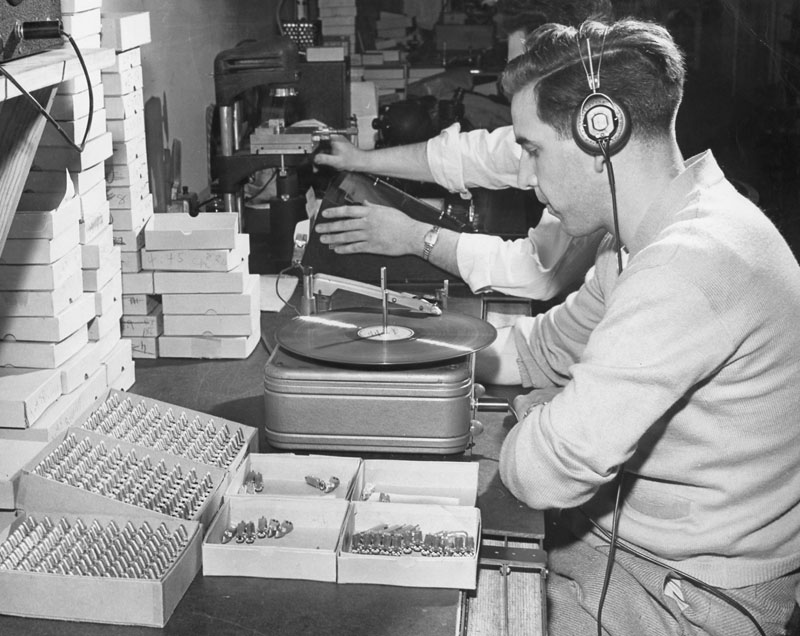
Listening Disc Jockey
Here is a picture taken in 1948 for the Sonotone Corporation byWain & Barsch, Inc., 37 West 57th Street, New York 19, N.Y. (Peter J. McGovern). The information on the back of the picture is as follows:
“Elmsford, N.Y. July 1948 --- Anthony Bozzuto spends his days at the Sonotone plant here spinning platters. But unlike radio’s disc jockies his job is listening, not entertaining. Tony tests phonograph pickups made of a ceramic material as part of an inspection to assure quality output. The gadget which goes into the phonograph arm and converts electrical impulses into electrical energy, is called “Titone,” first-man made substance with piezo-electrical qualities. It was developed by the Sonotone Corporation, hearing aid manufacturers. Crystals heretofore were widely used in pickups. Tony plays popular records as well as a special platter with sounds of varying frequencies.”
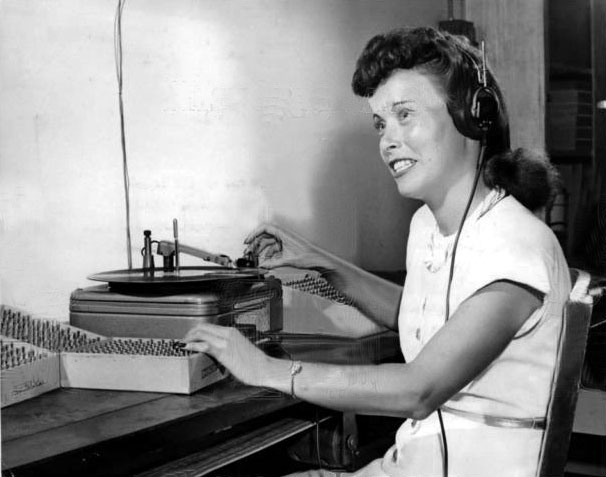
1948
Press photo
Dolores Poorman making a listening test for phono cartridges in Quality control
at the Sonotone Corporation.
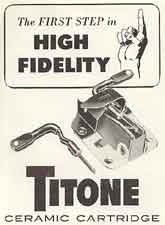 Sonotone advertised the Titone ceramic cartridge in the
January and March 1954 issues of Service, a technical journal of the
television and radio trade.
Sonotone advertised the Titone ceramic cartridge in the
January and March 1954 issues of Service, a technical journal of the
television and radio trade.
“No other cartridge gives all these features!”
“No preamplifier or equalizer needed--Unaffected by moisture or temperature--Wide frequency range--Outstanding response--High Sensitivity--Low distortion--High compliance--No hum pickup--Superior tracking ability--Wide adaptability--Proper groove fit--Only needle rotates--Simple to replace.
Titone Ceramic cartridges are unaffected by temperature and humidity. They do not deteriorate on the shelf or in equipment, as crystals do. The ceramic principle is an original discovery and development of the Sonotone laboratories. The demand for Titone is growing daily. More and more quality-conscious manufacturers are specifying Titone for original equipment. The same high quality is available to you in every Titone ceramic pickup cartridge.”
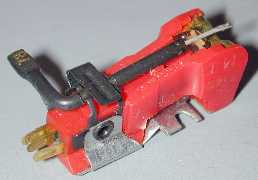 Perhaps the most popular stereo cartridge beginning in
the late 1950s was the 8TA stereo cartridge (right). Sonotone also made a wide
variety of low cost replacement cartridges and needle assemblies. The
replacement cartridge catalog contained 5700 cross-references which are too
long to reproduce on this page.
Perhaps the most popular stereo cartridge beginning in
the late 1950s was the 8TA stereo cartridge (right). Sonotone also made a wide
variety of low cost replacement cartridges and needle assemblies. The
replacement cartridge catalog contained 5700 cross-references which are too
long to reproduce on this page.
In 1959, I started my first job as an engineer at Sonotone. I began in phonograph cartridges, but the following year I had to take a leave of absence for a six-month tour of duty in the Signal Corps. Sonotone had a history of supplying the military with various equipments. With the recommendation of Raul Ferillo at Sonotone, I was able to be assigned to the Audio Development Section of the US Amy Signal Research and Development Laboratory at Ft. Monmouth, New Jersey. When I returned to Sonotone, there was a position available for me to work in microphone research and development and I took that. In addition to designing microphones, part of my time was also spent on developing new Sonotone loudspeaker products. I stayed with Sonotone for eight years.
In 1959, Norman Dieter, Jr. was the chief engineer in charge of cartridges and tape heads. He reported to Harry Pearson, director of research. After Norman left in the mid sixties, Sam Shatavsky, who was the engineer responsible for tape head development, replaced him. Tape heads were discontinued about 1965.
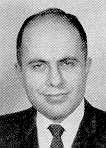 Phil Kantrowitz was a senior design engineer. He
started at Sonotone in 1954. Phil wrote several papers for the Audio
Engineering Society while he was employed at Sonotone. His first paper was
titled Reproduction distortion--It's Measurement and Influence on Stereo
Phonograph Cartridge Design and was presented at the Twelfth Annual
Convention of The AES in October, 1960. I advised and assisted him in preparing
his second paper; Distortion Measurements of High-Frequency Loudspeakers
presented at the Thirteenth Annual Convention in October, 1961. In the next few
years Phil presented even more papers titled: High frequency Stylus-Groove
Relationships In Phonograph Cartridge Transducers (1962), Mechanical
Impedance Measurements at the Stylus of Stereo Phonograph Cartridge Transducers,
Electrical Loading Networks for Stereo Phonograph Cartridge Transducers,
and Transducer Development for the Artificial Heart or Heart Assist Devices
(1967). Phil was also a member of the SMPTE and IEEE.
Phil Kantrowitz was a senior design engineer. He
started at Sonotone in 1954. Phil wrote several papers for the Audio
Engineering Society while he was employed at Sonotone. His first paper was
titled Reproduction distortion--It's Measurement and Influence on Stereo
Phonograph Cartridge Design and was presented at the Twelfth Annual
Convention of The AES in October, 1960. I advised and assisted him in preparing
his second paper; Distortion Measurements of High-Frequency Loudspeakers
presented at the Thirteenth Annual Convention in October, 1961. In the next few
years Phil presented even more papers titled: High frequency Stylus-Groove
Relationships In Phonograph Cartridge Transducers (1962), Mechanical
Impedance Measurements at the Stylus of Stereo Phonograph Cartridge Transducers,
Electrical Loading Networks for Stereo Phonograph Cartridge Transducers,
and Transducer Development for the Artificial Heart or Heart Assist Devices
(1967). Phil was also a member of the SMPTE and IEEE.
Cartridges were tested in a room with controlled temperature and humidity. Ballantine AC voltmeters were used throughout the lab as they had a linear dB scale. Test records such as Cook 10LP and Westrex were used. Sound Apparatus chart recorders were used, including a special dual channel recorder with doublewide paper. Response and separation could be displayed at the same time.
In 1962, the CBS STR 100 test record became available. It was adapted for use with the General Radio 1521-A Graphic level recorder. The January-February 1962 issue of the General Radio Experimenter contained an article titled "Automatic Measurement of Phonograph Reproducers" by B.B. Bauer. An automatic start circuit was described using the 1000 cycle tone at the beginning of each glide to automatically start the chart recorder. Arnold Schwartz and A. Gust at CBS developed this. It became a standard test at Sonotone.
The heart of the ceramic phono cartridge is a piezoelectric material, called lead-zirconium titanate. This material has a unique electro-mechanical property. A mechanical stress, such as bending, produces a voltage from one side to the other. The behavior is very much like the earlier Rochelle salt crystal used in crystal cartridges. The ceramic material, however, has much greater stability to both temperature and humidity.
Ceramic material is very linear. The peak output voltage is almost unlimited. Since no coils are involved in the construction, the ceramic cartridge is much less susceptible to hum pickup. Some early magnetic cartridges had other problems. The Fairchild 220, for example, had such a strong external magnetic field, it was strongly attracted to a steel turntable and could literally crush the needle assembly when lowered on a record.
Another unique feature of the ceramic cartridge is that it's response is amplitude based instead of velocity based like magnetic cartridges. This means that phono equalization is not required. The cartridge, when electrically loaded with 1 megohm or more, will produce a flat response with a typical output voltage of 0.4v. It does not require the extra stages of amplification. In low-cost phonographs, the cartridge is used to drive the output tube directly. An example is the 50EH5, that can deliver 1.4 watts when used in this manner.
Although Sonotone made many monophonic cartridges, the 3T cartridge is perhaps the best. The ceramic element material is in the shape of a bar. At the rear of the cartridge, one end of the ceramic element is sandwiched tightly between high durometer rubber pads. A gold plated brass connector is inserted between the ceramic element and the rubber, one on each side. The brass pieces extended out of the rear of the cartridge to form the cartridge connections. The other end of the ceramic element is glued to a brass piece that has a U shaped groove protruding from the front. The entire cavity around the ceramic element is injected with silicone damping compound. The stylus armature rests in the U shaped groove. Sideways motion of the stylus can then bend the ceramic bar and generate an output voltage. The stylus armature can be axially rotated by 180 degrees with no effect on performance. A 1 mil stylus can be mounted on one side for LP records and a 3 mil stylus can be mounted on the other for 78's. A simple turnover lever is all that is needed for the change. This also makes removal of the stylus assembly very easy for replacement. The needle assemblies are made with a variety of stylus sizes as well as in diamond and sapphire.
Stereo records required a new approach. A resolver in the form of a pantograph is found to work very well and is patented. It becomes the basis for the Sonotone stereo cartridges. The ceramic bar elements are mounted at 90 degrees to each other and 45 degrees to the vertical. The mounting methods for the ceramic elements include high durometer rubber pads, brass connectors, and silicone damping compound similar to the monophonic cartridges.
A flexible butyl rubber link is used between the lever arm and the needle shank. It is called the SONO-FLEX needle. This makes the stylus/armature relatively indestructible to accidents, like dropping the arm on the record, or dragging the stylus across the record. It can even flex in a 360 degree orbit and spring back in place.
The response of the ceramic cartridges, like the 9T are somewhat limited to 10 or 12kHz. At the time, however, disc cutters were struggling to get response on the records above 9kHz.
|
|
|
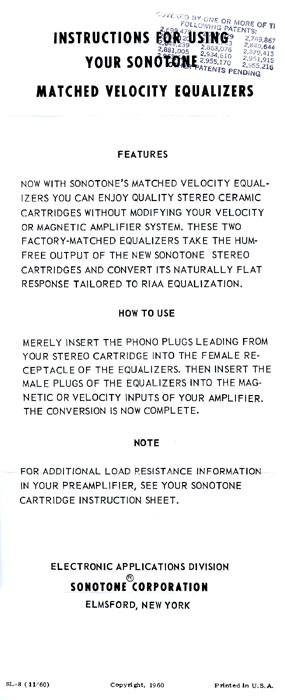
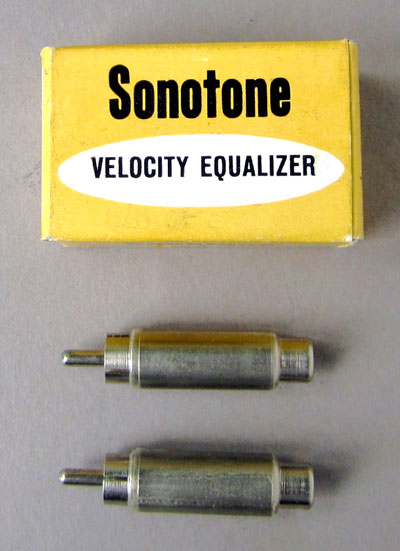
As popularity of magnetic cartridges increased, many preamplifiers no longer provide a ceramic cartridge input. To maintain sales of ceramic cartridges, the output of the ceramic cartridge is changed to look like a magnetic cartridge. The output is reduced and shaped by a passive RC network. In 1960, the first version is incorporated into a pair of small plug-in adapters for stereo. Later marketing gave them the name of Velocitone. The adapters are less than 2" long and can be plugged into a normal magnetic phono input and the turntable output can be plugged into the adapters. The inherent advantage of linearity and insensitivity to hum pickup can still be retained. The 9T ceramic stereo cartridge with Velocitone adapters is reviewed in the September 1961 issue of Electronics World.
The 9T Mark IV cartridge is a significant improvement over the 9T. Response goes out to 20kHz, although somewhat peaked at 15kHz. Separation also decreases at 15 kHz indicating resonance is occurring at that frequency. The Mark IV cartridge with Velocitone adapters is reviewed in the May 1965 issue of High Fidelity.
The 100T cartridge is a further improvement over the Mark IV. Response is much smoother, although the 15kHz peak remains. The 100T cartridge with Velocitone adapters is reviewed in the November 1966 issue of High Fidelity magazine.
The 100T Mark V cartridge maintains response out to 20kHz, although somewhat peaked at 15kHz. Separation again decreases at 15kHz indicating resonance is still at that frequency.
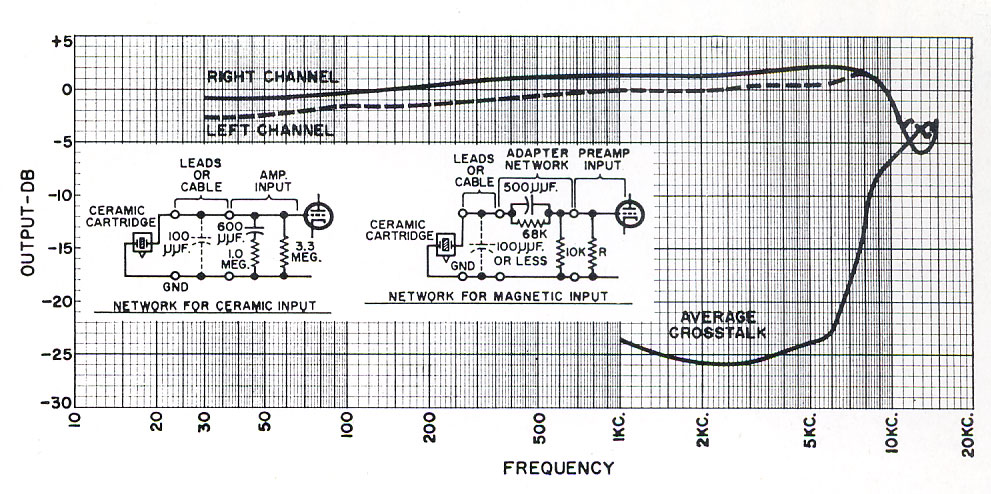
Typical network for the Sonotone 9T series cartridges
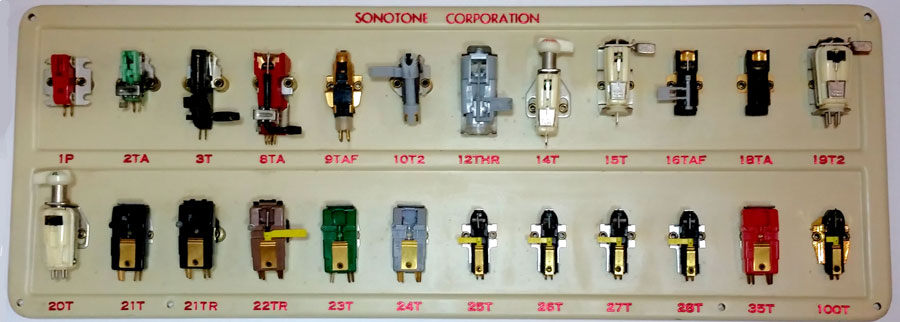
This board makes it easier to identify all of the Sonotone cartridges
Whatever became of the Sonotone cartridges?
About 1965, Sonotone was bought by the Servel Corporation and was later owned by the Clevite Corporation.
In April of 1969, the Astatic Corporation, a long time competitor, purchased the Audio Products line of Sonotone from the Clevite Corporation. This included the phonograph cartridge, needle and microphone products, production tools, dies and inventory of finished and semi-finished materials, as well as domestic patent rights. A year earlier, Astatic had purchased the Euphonics Corporation, also makers of ceramic cartridges and needles. Sonotone continued with hearing aids and accessories, as well as rechargeable nickel cadmium batteries.
No known significant advancements or innovations for the ceramic cartridges were made at Astatic. In 1987 they were bought by CTI Audio, Inc., Conneaut, OH. The Astatic products are now only microphones and accessories.
The ceramic cartridge lived on, however, and continued to evolve at Micro-Acoustics. Both Arnold Schwartz and Norman Dieter, both formerly of Sonotone, had much experience with design and manufacture of these cartridges. Improved versions continued. See the section on Micro-Acoustics.
|
|
A complete list of Sonotone phono cartridges as of 1966. |
|
|
|
A complete list of slim tonearm/cartridges. |
|
|
|
A complete list of crystal and monophonic replacement needles for Sonotone cartridges. |
|
|
|
A complete list of ceramic and stereophonic replacement needles for Sonotone cartridges. |
- 1966 suggested list prices.
1P Mono single needle ceramic. Response 20-20kHz (flat to 12kHz). Output 1.0v. Compliance 1.0. Load 1-5 megohms. Tracking force 8-10 grams. [1P-1S Price $6.10]
2TA Mono turnover ceramic. Response 20-20kHz (flat to 12kHz). Output 1.0v. Compliance 2.0. Load 2-3 megohms. Tracking force 6 grams. [2TA-S Price $7.40]
3T Mono turnover ceramic. Response 20-20kHz (flat to 15kHz). Output 0.5v. Compliance 2. Load 2-3 megohms. Tracking force 4-6 grams. [3T-S Price $9.75]
8TA Stereo/Mono turnover ceramic. Response 20-20kHz (within 2.5dB, 20-15kHz). Output 0.3v. Compliance 3.0. Separation 20dB. Load 1-5 megohms. Tracking force 4.6 grams for changers, 3-5 grams for professional arms. [8TA4-SD Price $14.50]
9TA F Stereo/Mono turnover ceramic. Response 20-20kHz (within 0.5dB, 20-6kHz, within 2dB 20-17kHz). Output 0.4v. Compliance 5.5. Separation 30dB. Load 1-5 megohms. Tracking force 3-5 grams for changers, 2-4 grams for professional arms. Universal terminal plug. Sono-Flex needle. [9TAF-SD Price $14.60]
9TAFHC Stereo/Mono turnover ceramic. Response 20-20kHz (within 0.5dB, 20-6kHz, within 2dB 20-17kHz). Output 0.2v. Compliance 15. Separation 30dB. Load 1-5 megohms. Tracking force 3-4 grams for changers, 1.5-3 grams for professional arms. Universal terminal plug. Sono-Flex needle. [9TAFHC-SD Price $15.15]
9T Velocitone Mark IV Stereo/Mono turnover ceramic. Response 20-20kHz (within 0.5dB, 20-6kHz, within 2dB 20-17kHz). Output 7mv. Compliance 15. Separation 30dB. Load 47k to 100k. Tracking force 3-4 grams for changers, 1.5-3 grams for professional arms. Universal terminal plug. Sono-Flex needle. Includes matched Velocitone equalizers. [9TAFHC-SDV Price $23.15]
10T2 Stereo/Mono turnover ceramic. Response within 2.5dB 20-15kHz. Output 0.5v. Compliance 1.5. Separation 18dB. Load 1-5 megohms. Tracking force 5-7 grams. Universal terminal plug. "Fuse clip" mounting. [10T2-SD Price $12.20]
12THA Stereo crystal. Response to 10kHz within 2dB. Output 2.5v. Compliance 1.4. Separation 20dB. Load 1/2 to 5 meg. Tracking force 9-11 grams. [12THR-S Price $6.95]
12TLA Stereo crystal. Response to 10kHz within 2dB. Output 1.5v. Compliance 2.2. Separation 23dB. Load 1/2 to 5 meg. Tracking force 6-8 grams.
14T Mono turnover crystal. Response: entire audio hearing range. Output 3.6v. Compliance 1.0. Tracking force 10 grams. [14T-S Price $3.15]
15T Mono turnover crystal. Response: entire audio hearing range. Output 3.6v. Compliance 1.0. Tracking force 10 grams. Boss mounted. [15T-S Price $3.15]
16TAF Stereo/Mono turnover ceramic. Response 20-12kHz (within 1.0dB, 20-10kHz). Output .65v. Compliance 2.4. Separation 25dB. Load 2 megohms. Tracking force 5-7 grams for changers, 4-6 grams for professional arms. Universal terminal plug. Sono-Flex needle. [16TAF-SD Price $11.65]
18TA Stereo/Mono turnover ceramic. Response 20-12kHz (within 1.0dB, 20-10kHz). Output 1.0v. Compliance 1.5. Separation 25dB. Load 2 megohms. Tracking force 5-7 grams for changers, 4-6 grams for professional arms. Universal terminal plug. Sono-Flex needle. [18TA-SD Price $11.00]
19T2 Stereo turnover crystal. Response: entire audio hearing range. Output 2.0v. Compliance 1.0. Separation 12dB. Tracking force 8 grams. Boss mounted. [19T2-S Price $4.40]
20T1 Stereo turnover crystal. Response: entire audio hearing range. Output 1.0v. Compliance 1.0. Separation 12dB. Tracking force 8 grams. [20T1-S Price $4.40]
20T2 Stereo turnover crystal. Response: entire audio hearing range. Output 2.0v. Compliance 1.0. Separation 12dB. Tracking force 8 grams. [20T2-S Price $4.40]
21T-S
21TR Stereo turnover ceramic. Response: entire audio hearing range. Output 0.6v. Compliance 5.5. Separation 21dB. Tracking force 4-7 grams. Retractable mounting bracket. Sono-Flex needle. [21TR-SD Price $12.20]
22T Stereo turnover ceramic. Response: entire audio hearing range. Output 0.3v. Compliance 10. Separation 24dB. Tracking force 2-4 grams. Snap-in mounting bracket. Sono-Flex needle. [22T-SD Price $12.20]
23T Stereo turnover ceramic. Response: entire audio hearing range. Output 0.4v. Compliance 10. Separation 26dB. Tracking force 2-4 grams. Snap-in mounting bracket. [23T-SD Price $13.10]
24T Stereo turnover ceramic. Response: smooth over entire audio hearing range. Output 0.25v. Compliance 4. Separation 21dB. Tracking force 4-7 grams. Capicitance 4500pf. Sono-Flex needle. For transistor applications. [24T-SD Price $13.95]
25T Stereo turnover ceramic. Micro-Ceramic light weight. Response: smooth over entire audio hearing range. Output 0.2v. Compliance 15. Separation 24dB. Tracking force 1-3 grams. [25T-MB-SD Price $14.70]
26T Stereo turnover ceramic. Micro-Ceramic light weight. Response: smooth over entire audio hearing range. Output 0.5v. Compliance 65. Separation 21dB. Tracking force 3-6 grams. [26T-MB-SD Price $14.70]
27T Stereo turnover ceramic. Micro-Ceramic light weight. Response: smooth over entire audio hearing range. Output 0.18v. Compliance 5. Separation 22dB. Tracking force 3-6 grams. Capacitance 4100pf. For transistor applications. [27T-MB-SD Price $15.45]
28T Stereo turnover ceramic. Micro-Ceramic light weight. Response: smooth over entire audio hearing range. Output 0.35v. Compliance 9. Separation 22dB. Tracking force 2-4 grams. [28T-MB-SD Price $14.70]
35T Stereo turnover ceramic. Response: smooth over entire audio hearing range. Output 1.0v. Compliance 1.5. Separation 20dB. Tracking force 6-8 grams. Capicitance 850pf. Sono-Flex needle. For transistor applications. [35T-SD Price $15.45]
100T Velocitone Mark V. [100T-DEV Price $39.50]

Slim Tonearm Complete With Cartridge
T14T-S Complete with 14T series mono crystal cartridge. Price $4.40
T20T1-S Complete with 20T1 series stereo cartridge. Price $5.70
T20T2-S Complete with 20T2 series stereo cartridge. Price $5.70
Ceramic and Stereophonic needles
N-8TA-S [0.7-mil sapphire and 3-mil sapphire] Price $3.15
N-8TA-S77 [dual 0.7-mil sapphire] Price $3.15
N-8TA-SD [0.7-mil sapphire and 3-mil diamond] Price $4.40
10T2-SLB [0.7-mil sapphire and 3-mil sapphire]
10T2-S77LB [dual 0.7-mil sapphire]
10T2-SDLB [0.7-mil diamond and 3-mil sapphire]
10T2-SD77LB [0.7-mil diamond and 0.7-mil sapphire]
N-12THR-S [0.7-mil diamond and 3-mil sapphire] Price $3.15
N-12THR-S77 [dual 0.7-mil sapphire] Price $3.15
N-12TLA-S [0.7-mil diamond and 3-mil sapphire] Price $3.15
N-12TLA-S77 [dual 0.7-mil sapphire] Price $3.15
N-14T-7D [0.7-mil diamond] Price $2.00
N-18T-S [0.7-mil sapphire and 3-mil sapphire] Price $3.15
N-18T-S77 [dual 0.7-mil sapphire] Price $3.15
N-18T-SD [0.7-mil diamond and 3-mil sapphire] Price $4.40
N-19T2-7S [0.7-mil sapphire] Price $.75
N-19T2-3S [3-mil sapphire] Price $.75
N-20T-7S [0.7-mil sapphire] Price $.75
N-20T-3S [3-mil sapphire] Price $.75
N-20T-7D [0.7-mil diamond] Price $2.00
N-21T-S [0.7-mil sapphire and 3-mil sapphire] Price $3.15
N-21T-S77 [dual 0.7-mil sapphire] Price $3.15
N-21T-SD [0.7-mil diamond and 3-mil sapphire] Price $4.40
N-25T-S [0.7-mil sapphire and 3-mil sapphire] Price $3.15
N-25T-S77 [dual 0.7-mil sapphire] Price $3.15
N-25T-SD [0.7-mil diamond and 3-mil sapphire] Price $4.40
N-25T-S(S) [0.7-mil sapphire and 3-mil sapphire] Price $3.15
N-25T-SD(S) [0.7-mil diamond and 3-mil sapphire] Price $4.40
N-26T-S [0.7-mil sapphire and 3-mil sapphire] Price $3.15
N-26T-S77 [dual 0.7-mil sapphire] Price $3.15
N-26T-SD [0.7-mil diamond and 3-mil sapphire] Price $4.40
N-26T-S(S) [0.7-mil sapphire and 3-mil sapphire] Price $3.15
N-26T-SD(S) [0.7-mil diamond and 3-mil sapphire] Price $4.40
N-27T-S [0.7-mil sapphire and 3-mil sapphire] Price $3.15
N-27T-S77 [dual 0.7-mil sapphire] Price $3.15
N-27T-SD [0.7-mil diamond and 3-mil sapphire] Price $4.40
N-27T-S(S) [0.7-mil sapphire and 3-mil sapphire] Price $3.15
N-27T-SD(S) [0.7-mil diamond and 3-mil sapphire] Price $4.40
N-28T-S [0.7-mil sapphire and 3-mil sapphire] Price $3.15
N-28T-S77 [dual 0.7-mil sapphire] Price $3.15
N-28T-SD [0.7-mil diamond and 3-mil sapphire] Price $4.40
N-28T-S(S) [0.7-mil sapphire and 3-mil sapphire] Price $3.15
N-28T-SD(S) [0.7-mil diamond and 3-mil sapphire] Price $4.40
*N-9916F-S [0.7-mil sapphire and 3-mil sapphire] Price $3.50
*N-9916F-S77 [dual 0.7-mil sapphire] Price $3.50
*N-9916F-SD [0.7-mil diamond and 3-mil sapphire] Price $4.75
*N-9916F-D77 [dual 0.7-mil diamond] Price $6.00
N-9916HC-S [0.7-mil sapphire and 3-mil sapphire] Price $3.80
N-9916HC-S77 [dual 0.7-mil sapphire] Price $3.80
N-9916HC-SD [0.7-mil diamond and 3-mil sapphire] Price $5.05
N-9916HC-D77 [dual 0.7-mil diamond] Price $6.30
N-100T-7D [0.7-mil diamond] Price $4.50
N-100T-5D [0.7-mil diamond] Price $5.50
N-100T-ED [elliptical 0.2x0.8 diamond] Price $8.50
N-35T-S [0.7-mil sapphire and 3-mil sapphire]
N-35T-S77 [dual 0.7-mil sapphire]
N-35T-SD [0.7-mil diamond and 3-mil sapphire]
*Sono-Flex needle. New & improved high compliance universal needle for 9T, 9TA, 9TAF, 9TV, 9TAV, 9TAFV, 16T, 16TA, 16TAF, 916T, 916TA and 916TAF series.
Note: (S) after model number indicates short turnover needle arm for slim tonearms and LB (less bracket) cartridge replacement.
Crystal and Monophonic Needles
N-1P-1S [1-mil sapphire for 1P cartridge] Price $2.85
N-1P-2S [2-mil sapphire for 1P cartridge] Price $2.85
N-1P-3S [3-mil sapphire for 1P cartridge] Price $2.85
N-1P-1D [1-mil diamond for 1P cartridge] Price $4.10
N-1P-3D [3-mil diamond for 1P cartridge] Price $4.10
N-2T-S [1-mil sapphire and 3-mil sapphire for 2T cartridge
N-2T-SD [1-mil diamond and 3-mil sapphire for 2T cartridge
N-2TA-S [0.7-mil sapphire and 3-mil sapphire for 2T cartridge Price $3.15
N-2TA-SD [0.7-mil diamond and 3-mil sapphire for 2TA cartridge Price $4.40
N-3P-1S [1-mil sapphire for 3P cartridge] Price $2.85
N-3P-3S [3-mil sapphire for 3P cartridge] Price $2.85
N-3P-1D [1-mil diamond for 1P cartridge] Price $4.10
N-3P-3D [3-mil diamond for 1P cartridge]
N-3T-S [1-mil sapphire and 3-mil sapphire for 3T cartridge Price $3.15
N-3T-SD [1-mil diamond and 3-mil sapphire for 3TA cartridge Price $4.40
N-14-TH-3S [0.3-mil sapphire] Price $.75
N-14-TH-1S [0.1-mil sapphire] Price $.75
N-15T-3S [3-mil sapphire] Price $.75
N-15T-1S [1-mil sapphire] Price $.75
N-19T2-3S [0.3-mil sapphire] Price $.75
|
About This Site |
||
|
|
More text and pictures about Sonotone will be added as my research continues. Any comments, corrections, or additions are welcome. |
|
|
|
|
Created
by Roger Russell |