Welcome to Roger Russell's
Gold Reference Page
Copyright 1996-2005 by Roger
Russell
All rights reserved
No portion of this site may be reproduced in whole or in part
without written permission of the author.
|
What's on this page? |
|
|
Introduction |
Collectible Gold Coins |
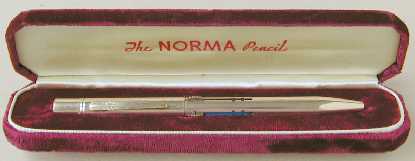
 Since becoming involved with several
different products involving gold, I really needed more information about this
element and it's various uses. I found that Norma gold pencils could be made
as either gold filled or rolled gold. Electrical connectors are now almost
always gold plated. It provides near corrosion free contacts that increase the
reliability in audio, computer and other communications equipment.
Since becoming involved with several
different products involving gold, I really needed more information about this
element and it's various uses. I found that Norma gold pencils could be made
as either gold filled or rolled gold. Electrical connectors are now almost
always gold plated. It provides near corrosion free contacts that increase the
reliability in audio, computer and other communications equipment.
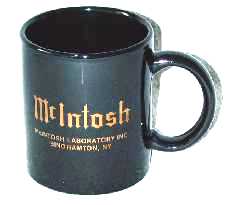 In designing souvenir mugs I found that gold lettering
was available instead of normal colored ink. At first the lettering was done
with 22k gold leaf. However, gold leaf is electrically conductive. When placed
in a microwave oven, currents are induced and can burn out the gold leaf or
even possibly damage some microwave ovens. To overcome this, a gold ink has
been developed that is made of fine gold particles that are insulated from each
other. The result is gold lettering that is non-conductive and safe for
microwave use.
In designing souvenir mugs I found that gold lettering
was available instead of normal colored ink. At first the lettering was done
with 22k gold leaf. However, gold leaf is electrically conductive. When placed
in a microwave oven, currents are induced and can burn out the gold leaf or
even possibly damage some microwave ovens. To overcome this, a gold ink has
been developed that is made of fine gold particles that are insulated from each
other. The result is gold lettering that is non-conductive and safe for
microwave use.
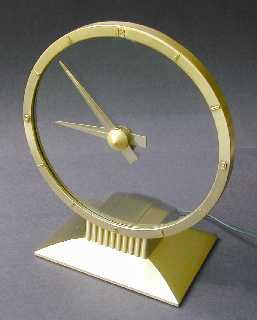 Several different clocks that
are thought to be brass or brass plated are actually 24k gold plated. One such
clock was made by Jefferson Electric. It was appropriately called
the Golden Hour clock. About 2 million of these were sold over a 41 year period
starting in December of 1949.
Several different clocks that
are thought to be brass or brass plated are actually 24k gold plated. One such
clock was made by Jefferson Electric. It was appropriately called
the Golden Hour clock. About 2 million of these were sold over a 41 year period
starting in December of 1949.
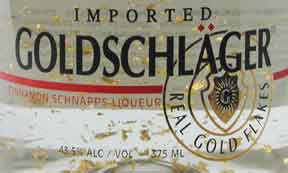 Of course there are many more
uses than just these few. One of the more unusual applications is for flakes of
gold leaf in a cinnamon schnapps liqueur called Goldschlager. Many years ago
this inspired John L. Hancock, a clock designer at Mastercrafters Clock and Radio Company, to design the Action
Starlight clock. It contained two tubes of viscous fluid with metal flakes. The
tubes were illuminated and heated by lamps underneath causing the flakes to
circulate.
Of course there are many more
uses than just these few. One of the more unusual applications is for flakes of
gold leaf in a cinnamon schnapps liqueur called Goldschlager. Many years ago
this inspired John L. Hancock, a clock designer at Mastercrafters Clock and Radio Company, to design the Action
Starlight clock. It contained two tubes of viscous fluid with metal flakes. The
tubes were illuminated and heated by lamps underneath causing the flakes to
circulate.

Gold has been
considered to be valuable for at least 5000 years and perhaps much further back
in time. It has been prized for it's rarity, beauty, easy workability and
indestructibility. Besides the physical qualities of gold, the Egyptians valued
it as symbolic of the gods. Early use of gold was accomplished by finding
nuggets and hammering them into shape without melting them. In the days of the
pyramids,
Of course, we all
know about the quest for gold by the European countries and what they found in
the empires of the Mayans, Incas and Aztecs. Then there were the treasure ships
that never made it back home and the treasure hunters that have recently
discovered a few of these wrecks. One of these treasure hunters was Mel Fisher
who finally found the Spanish ship Itocha that sank near the

I visited the

One of the gold “finger”
bars was on display in an enclosed clear plastic box. A hole in the center allowed
you to reach in and actually lift a real piece of the recovered gold. Of
course, it was surprisingly heavy.

We also know about
the gold rushes in
The average demand
for gold in the past 10 years has been mainly for jewelry at 76%, followed by
industrial applications of 14% and 10% for investors. The top ten gold
producing countries are
The universal
standard for weighing gold is the
|
American Marking |
% Fine Gold |
European marking |
|
24k |
100% |
.999 |
|
22k |
91.6% |
.916 |
|
18k |
75% |
.750 |
|
14k |
58.5% |
.585 |
|
10k |
41.6% |
.416 |
Based on 1976
information, 10k is the legal minimum accepted standard of gold karatage in the
Gold can be alloyed
in a range of colors but only a few alloys have the right combination of
strength, beauty and workability to qualify for use in jewelry.
 Most jewelry contains a mixture
of at least two other metals. To retain gold's natural color and increase it's
hardness, it is alloyed with a combination of copper and silver. Green gold is
achieved when silver, and sometimes small amounts of copper and zinc are used
as alloys. A pink or red tint results when gold is alloyed with copper. White
gold is made by combining gold with copper, nickel and zinc.
Most jewelry contains a mixture
of at least two other metals. To retain gold's natural color and increase it's
hardness, it is alloyed with a combination of copper and silver. Green gold is
achieved when silver, and sometimes small amounts of copper and zinc are used
as alloys. A pink or red tint results when gold is alloyed with copper. White
gold is made by combining gold with copper, nickel and zinc.
Small amounts of
alloy metals can make a noticeable difference in the color of these coins. For
instance: at the left side of the picture is a Canadian maple leaf coin that is
99.99% gold. The coin on the right is an American bullion Eagle that is 91.67%
gold plus copper and silver. The pure gold is noticeably yellow in comparison.
Because the American eagle is alloyed, I will show less wear over time. In
comparison, the pure gold Canadian maple leaf will show wear and scratches much
more easily.
Gold Filled--A
process by which a layer of at least 10k gold has been mechanically bonded to a
base metal. this layer must constitute at least 1/20th of the total weight of
the metal in the piece. Items must be marked gold filled preceded by the karat
fineness of the plating. e.g. 14k gold filled.
Rolled Gold Plate--Same
as gold filled except the quantity of karat gold is less than 1/20th of the
total metal weight. It must be identified with a fraction indicating the
quantity of gold, e.g. 1/40 12k R.G.P.
Solid Gold-- A term
that some would reserve for fine or 24k gold because it contains no other
metals. However, in 1967 the federal Trade Commission held that solid gold may
be used to describe articles that do not have a hollow center and are 10k or
finer.
Gold Leaf--Developed
by Egyptians 6500 years ago. Gold can be beaten to a thickness of only 4
microns and used for many different ornamental purposes..
Troy Ounce--Part of
the system of Troy weight used for measuring metals based on a pound having 12
ounces and is 31.103 grams per ounce. Gold is measured worldwide in
Avoirdupois Ounce--Based
on a pound having 16 ounces and an ounce having a weight of 28.349 grams.
Gold, Gold Coins and the
 Gold was a
recognized medium of exchange in the
Gold was a
recognized medium of exchange in the
Pictured at the
left are the $1.00 Liberty Head and the $2-1/2 Indian head coins. The
By 1945, gold
reserves for federal Reserve Notes and deposits decreased from 35% to 25%. The
year 1964 saw the last time silver coins were minted by the government. Up
until 1968 the price of gold was fixed at $35 an ounce. After that, prices rose
sharply. In 1971 Nixon ended the redeemability of federal Reserve notes and
deposits. On
 In 1986, the
At first, I didn't
understand the nature of these coins. For instance, on the largest gold eagle
coin it says "1 ounce fine gold," but it weighs 33.930 grams and 1
Other popular
bullion coins available today include the Australian Kangaroo Nugget, the
Austrian Philharmonic, The Canadian Maple leaf and the South African
Krugerrand. Investment coins are valued only by the current price of gold
whether they are circulated, proof or not.
Numismatic, or
collector coins, are valued for rarity, age and condition. These can be proof
sets and/or low mintage items and can sell for a much higher prices. They are
sought for their beauty and historical significance. They can be an investment
in the sense that the collector value may go up. The history of these coins is
very interesting. It includes information about the designer, how many were
minted, when and where they were minted, composition, etc. Typically, the coins
are available enclosed in a sealed clear plastic container.
 One such
history is about the St. Gaudens coin. In late 1905 President Theodore
Roosevelt asked Augustus St. Gaudens, a famous American sculptor, to redesign
the $10.00 and eagle and $20.00 double eagle. The result is one of
One such
history is about the St. Gaudens coin. In late 1905 President Theodore
Roosevelt asked Augustus St. Gaudens, a famous American sculptor, to redesign
the $10.00 and eagle and $20.00 double eagle. The result is one of
 However, there are two
different versions of this coin.
However, there are two
different versions of this coin.
The $20.00
 Gold leaf is made by squeezing
gold into thinner and thinner sheets. It can be applied to practically anything
with a suitable adhesive. It can be used on clothing, glass, wood or anything
else and have the appearance of being completely made of gold. Typically it
comes in a "book" of 25 leaves measuring 3-3/8" by 3-3/8".
Each sheet is separated by a piece of neutral paper. Gold leaf is available in
various karat grades up to 24k. The gold is so thin, it often must be handled
with a special brush.
Gold leaf is made by squeezing
gold into thinner and thinner sheets. It can be applied to practically anything
with a suitable adhesive. It can be used on clothing, glass, wood or anything
else and have the appearance of being completely made of gold. Typically it
comes in a "book" of 25 leaves measuring 3-3/8" by 3-3/8".
Each sheet is separated by a piece of neutral paper. Gold leaf is available in
various karat grades up to 24k. The gold is so thin, it often must be handled
with a special brush.
The picture at the
left is a typical gold leaf book with the cover folded open and exposing the
first sheet. Care must be taken not to breathe too hard on it as it can fly
away. This particular gold is 23k. Gold leaf, brushes and adhesives can be
purchased at various art stores. This particular book costs about $30.00. It
will cover about 2 square feet.
Where does gold
come from? It is formed literally from the stars. Our own sun generates only
the lighter elements. Supernovae do emit some heavier elements up to nickel,
lead, gold and even uranium. Current thinking is that this accounts for only 5%
of the heavy elements. It is thought that infrequent collisions of neutron
stars could account for the remainder. Neutron stars are so compact that they
contain the mass of the sun in an area the size of a city. When the earth was
formed, gold and the other heavy elements were included from the debris in space.
Bacteria in the
earth play an integral role in creating deposits of gold. They can survive far
below the ground where there is no oxygen. Acids secreted by the bacteria break
down the rock and mineral ores. Molecules of gold are attracted to the outer skin
of the bacteria. Over time, the gold builds up to form a glittering gold
deposit. The process of continental drift by the earth's crust and natural
stratification may also contribute to forming veins of gold as well as copper,
silver and other elements. that we find in the rock today. Gold is often found
embedded in quartz.
|
Chemical
Symbol Au |
Atomic Number 79 |
A comparison with other elements
|
Element |
Atomic weight |
Density |
|
Zinc |
65 |
7.1 |
|
About This Site |
||
|
|
More text and
pictures about gold will be added as my research continues. Any comments,
corrections, or additions are welcome. |
|
|
|
Created by Roger Russell |
|
|
|
|
|
|
|
All contents are copyright 2000-2005 |
|
|
|
|
|