Jefferson Exciting Hour
By Roger Russell
These
pages are copyrighted
No portion of this site may be reproduced in whole or in part
without written permission of the author.
Catalog number 580-301
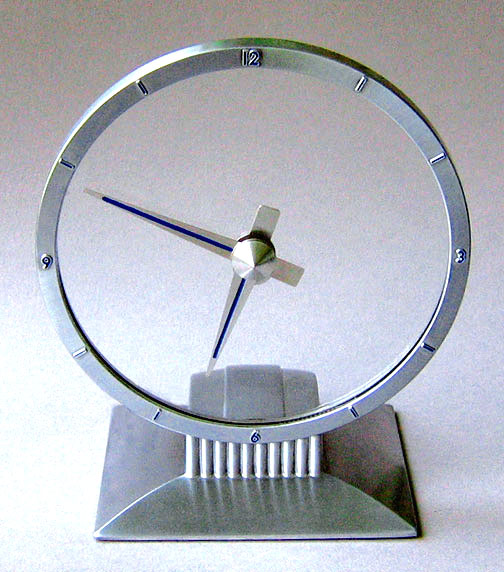
The Exciting Hour is almost identical to the Golden Hour but has a brushed chrome finish. This model appears to have been made for only a short time and in a much smaller quantity than the Golden Hour. Dimensions are 8-7/8" high and the outside diameter of the dial is 7-7/16". Depth is 4-1/2". Weight is 2.3 lbs. The glass is 3/32" thick. The outer ring is made of a cast zinc alloy, the same as that used in the Golden Hour. See my page showing a cross section and a metal analysis. It is plated with chromium and has a brushed satin finish. The retainer ring on the back of the clock is steel and plated with chrome. The glass is mounted in a steel, nickel plated ring gear. It is single strength select grade glass and is 3/32" thick. Replacement glass instructions are available including the purchase of shatter resistant acrylic instead of glass.
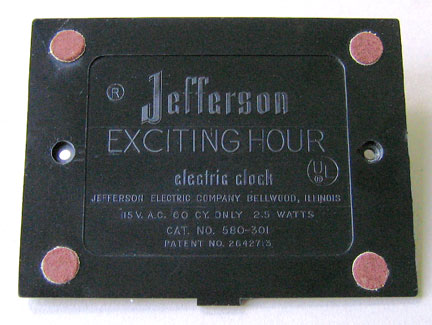
The clock is powered with an International Register synchronous motor located in the base. The output gear from the motor gearbox has 27 teeth and rotates at 1/6 rpm. It mates with the rim gear that has 270 teeth. This 10:1 reduction results in the glass turning at the required 1/60 rpm, or one revolution per hour.
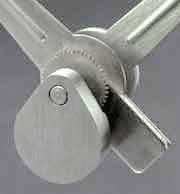 The picture at the right shows the rear of the hands
and the pear shaped counterweight assembly. The minute hand is located at front
of the glass and is attached to it by friction so that it can be easily turned
to set to the desired minutes. The hour hand and gear assembly are located
behind the glass and can turn freely. A shaft attached to the center of the
glass has a gear in the counterweight gear assembly. The counterweight always
stays in a vertical location and provides a fixed position needed to drive
other gears that advance the hour hand as the glass turns.
The picture at the right shows the rear of the hands
and the pear shaped counterweight assembly. The minute hand is located at front
of the glass and is attached to it by friction so that it can be easily turned
to set to the desired minutes. The hour hand and gear assembly are located
behind the glass and can turn freely. A shaft attached to the center of the
glass has a gear in the counterweight gear assembly. The counterweight always
stays in a vertical location and provides a fixed position needed to drive
other gears that advance the hour hand as the glass turns.
A small counterweight of metal is attached to the rear portion of the hour hand. It's the same shape and can be seen behind the main counterweight near the bottom of the picture at the right. It serves to hold the hour hand in proper position relative to the minute hand. See my page for information on troubleshooting, restoration and improvements of these clocks.
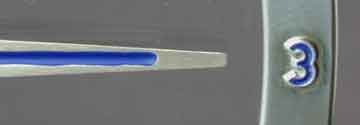 The ring has raised numerals at 3, 6, 9, and 12
o'clock as well as raised radial lines at the other hours. These are filled
with blue paint instead of the radium
paint used on many of the Golden Hour , Golden Minute and Golden View
clocks. The hour and minute hand have a blue line along the center.
The ring has raised numerals at 3, 6, 9, and 12
o'clock as well as raised radial lines at the other hours. These are filled
with blue paint instead of the radium
paint used on many of the Golden Hour , Golden Minute and Golden View
clocks. The hour and minute hand have a blue line along the center.
The date of manufacture is usually stamped inside the base and can be seen by removing the two screws holding the black bottom plate. The date on this clock is 8-16-60, which probably means it was made on August 16, 1960.
Here's a side by side comparison of the Golden Hour and the Exciting Hour. The frame and base appear to be made from the same basic zinc alloy casting. The plating would be the only difference.
|
|
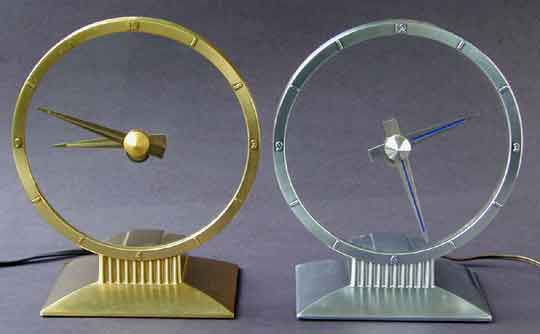
In the gold plating process, the parts are first plated with nickel. This provides better adhesion for the gold plating. Although the same primary plating process may have been used for the Exciting Hour, the final plating is not nickel. It is advertised in Jefferson literature as a satin chrome finish.
Jefferson picture and text from an advertisement:
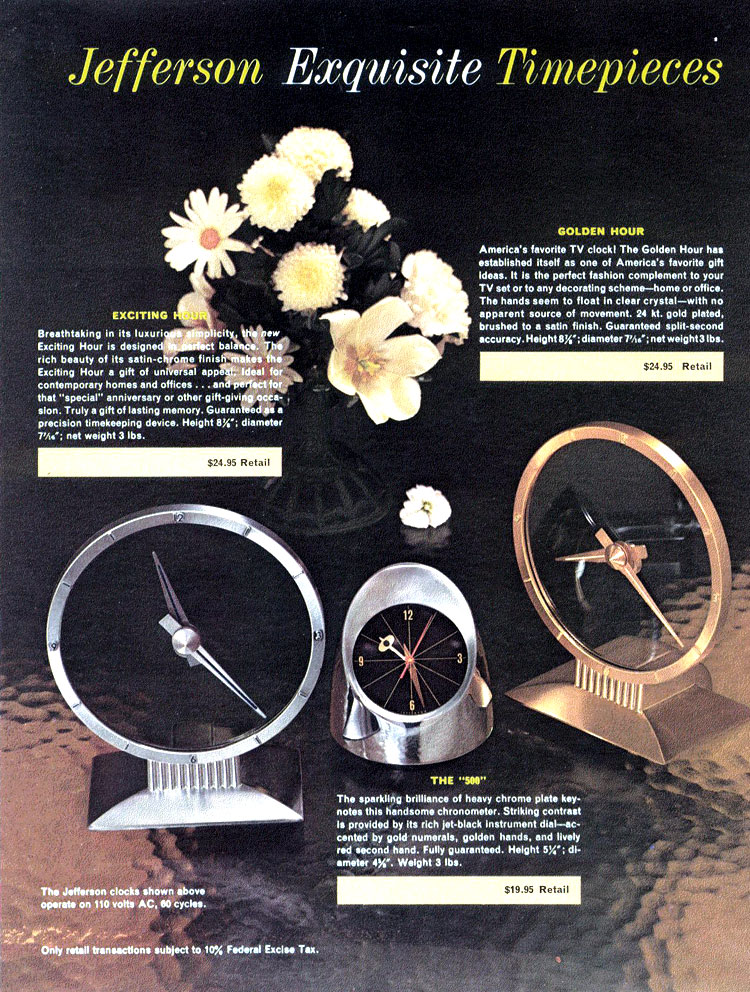
The patent, 2,642,713, is actually for a different clock made by the Etalage Reclame Corporation of New York. Jefferson bought the patent rights and restyled it to become the Golden Hour, Golden Minute, Golden View and Golden Helm. For more information, see The Clocks of Leendert Prins
|
About This Site |
||
|
|
More text and pictures about Jefferson will be added as my research continues. Any comments, corrections, or additions are welcome. |
|
|
|
|
Created
by Roger Russell |