Welcome to Roger Russell's

A Mixture of Truth and Humor
These
pages are copyrighted/
No portion of this site may be reproduced in whole or in part
without written permission of the author.
What's on this page?
For the truth about speaker wire, see my Speaker Wire History Page.

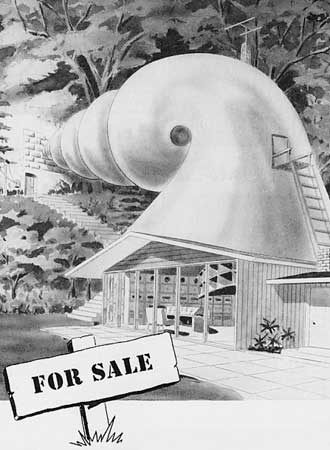
Does anyone remember this Norelco ad from Audio magazine March 1958?
|
|
"Practically new ranch house with 200-foot poured-concrete, spirally curled, exponential, bass horn; 12-foot multicellular midrange horn (24 cells); large inventory of assorted dynamic and electrostatic tweeters; three 2000-watt water-cooled amplifiers; infinite-attenuation electronic crossover networks; master control-mixer-preamplifier console; two 1,500-lb. belt driven turntables suspended in mercury bath; vacuum sealed record-positioning chamber with servo controlled record lifters and nuclear-reactor record deionizer; foam-rubber basement for acoustical feedback isolation; also complete blueprints for construction of identical house for stereo." |
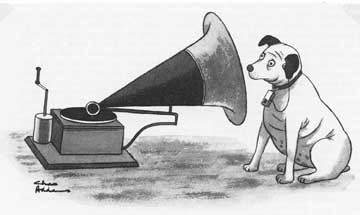
Poor Nipper.
He spent too much time in front of that horn speaker.
See my page on Listening
and Hearing
Audio on the web appears to be cluttered with far out opinions and ridiculous claims followed by emotional criticism. The element of humor seems to be forgotten. One of the early publications from the 1950's making fun of audio was Emory Cooks "Audio Bucket". Then there were years and years of priceless cartoons by Charles Rodrigues. They started in High Fidelity magazine and ended in Stereo Review. Swann and Flanders made a record in the 1950's called At the Drop of a Hat that included a song called "Song of Reproduction" which was all about the joys and sorrows of hi-fi. (Angel 65042)
Your critical observations in audio are valuable. Contributions of funny audio one-liners and especially audio limericks are very welcome. This page is close to G rated so they should be geared appropriately. I can't guarantee all of them will be used but credit will be given to those that are used.
Input Impedance Definition
High input impedance is often encountered when the husband is caught by the housewife as he tries to bring new speakers or other conspicuous components in the front door. This can be referred to as crossing the threshold to high input impedance. For many husbands this is a confounding situation. However, when consulting with other husbands, who have had a similar experience, he can learn how to use an impedance transformer that is essential to overcome the problem. The best type of transformer which almost always works is DIAMONDS! This lowers input impedance dramatically and depending on the number, size and quality, can keep the impedance low, even for several years.
|
A break-in period is an excuse made up by some audio manufacturers to get your ears used to the bad sound. |
|
Believing is hearing. That’s right, if you believe you will hear a difference, then there's a good chance that you will. |
|
The more components sound alike, the more inventive people become about describing the differences they think they hear. |
|
No speakers are perfect. You decide on one that has qualities you like and learn to live with the rest.....like women......or men. |
|
Eskimos have been using series and parallel woofers for hundreds of years. |
|
There are no "golden eared" listeners. There are just ordinary people who have learned what to listen for. The less that a person knows, the more imaginative story they can make up. |
|
A TV repair girl named Misty An avid DX'er named Crumb |
There once was a man from Deering When testing his speaker for power |
|
A tube nut by the name of Glen There was a man named Able |
A tube hoarder named Ben
|
You may NOT be an audio enthusiast if you think:
A listening test is used when your wife wants to see if you are paying attention.
A blind test is used to see if the slats open and close properly.
Low cut reveals cleavage
Fidelity is part of your marriage vows
A CD is some kind of bank deposit.
Frequency response is some kind of erectile requirement.
Tolerance is what you put up with in a marriage.
Input impedance is when your wife sees you trying to bring in a new set of speakers.
Output impedance is when your wife tries to throw out your speakers.
A listening room can be any room where your wife is talking to you and you better be looking at her.
Woofer is another term for a dog
Sub-woofers are submarine mascots.
Squawkers are chickens.
Tweeters are a description for birds.
Super tweeters are weakened by kryptonite.
Male and female connectors are pornographic.
Canon plugs are used to keep the water out.
Power amplifiers are hired hit men
Internal impedance is solved with laxatives
Damping factor is part of a weather forecast
Equalizers are guns and knives
A loudspeaker might be your mother-in-law
Recorders are musical instruments.
A tuner is a kind of sandwich.
White noise is made by white politicians.
Distortion is when you make faces.
A narrow band is when the players are all in single file.
Wide band is when players are all in line.
A balance control is used by a tight-wire walker.
A choke is used to control your dog.
A volume control is used to fill your beer bug.
Cartridges are used to load your hunting gun.
A crossover means driving on the wrong side of the road.
A terminal strip is a topless dancer with a heart problem.
Digital sound means tapping your fingers on the table.
Do all CD Players Sound the Same?
Tests for response and distortion in CD players all turn out very well. The measurements show that distortion is extremely low and response is ruler flat. CD players have eliminated the differences between phono cartridges. They have also eliminated pops and clicks and those inevitable scratches on the records that seem to appear out of nowhere. They have also eliminated problems of dust, turntable rumble and playback loss. Despite all of these advantages, there are still listening differences.
If you have only heard one CD player, you may have enjoyed all of the advantages without being aware that there are still differences. In an A-B comparison, response is the same, even when compared with a steady source such as pink noise. Harmonic and intermodulation distortion are so low that the players all sound very clean.
The difference is something new and may require a readjustment to know what to listen for. The difference is in imaging. It is most easily heard using speakers that have exceptional imaging capabilities, like my new speaker system. However, regardless of what speaker is used, it is almost impossible to convey a listening experience in words. Nevertheless, I will try to describe what I have heard. I have used a McIntosh MCD7005, McIntosh MVP851and a McIntosh MVP851 supplemented with a McIntosh MDA1000 digital to analog converter for the listening tests. I made these tests in late 2004 and early 2005. My listening was done in two different ways. The first was in instant switching between the two choices and the second was long term listening to each.
Imaging using the 7005 appears to be very wide with orchestral music but there was separateness of the sound with the left and right speakers. I had always assumed this was the way the recordings were made. On the other hand, some new age recordings seemed to completely envelop the listener. That was very pleasing. It was only when I began using the 851 that I noticed there was a difference in imaging. Classical music sounded like it had much better coherence and less separateness, giving it more clarity and sense of aliveness. However, it was more than just imaging. It was a new kind of distortion difference, more like a phase distortion of some kind that affected the coherence of the image. The 851 was made in 2004 and the older 7005 was made in 1987.
The explanation had a definite physical cause. It was the digital-to-analog filtering. The filtering was significantly improved in the 851. What I was hearing was confirmed by McIntosh engineering. It was also pointed out that some people preferred the sound of the lesser filtering. I was in agreement when it came to new age music. I liked being enveloped in the sound. However, the spaciousness provided in some new age music is all synthesized. There is no real world reference to hearing this music except through loudspeakers or headphones, whereas, classical music has a real world reference and it is that which guided my decision in my search for improved accuracy. I accepted the new age music, with the improved filtering, as it was probably intended to be that way.
The experiment went further when I added the 1000 D-to-A converter to the 851. The digital output of the 851 is fed to the D-to-A converter prior to the filtering. The 1000 converts the digital signals to 786 kHz with 24 bit resolution before converting to analog. This is literally the best filtering possible. The kind of listening experience was similar but not as pronounced. There was a further improvement in coherence and a little more loss of separateness between the speakers. The difference was getting to the point that it wasn’t always audible, depending on the program material. Having heard this further improvement, it became my new reference. (see my section on what constitutes a good amplifier)
After extended listening using the MDA1000, I have found that two or three objectionable CD’s now sound much more acceptable. Again, I had thought this was what was in the recording. It can be described as harshness or overbright at high frequencies. Two of these are Richard Burmer Mosaic on American Gramophone and Respighi Church Windows on Telarc. It is known that some recent releases of CD’s have been overmodulated in the recording process producing very distorted sound. Earlier releases of the same recordings did not have this. It may be confined only to some popular music at this time. Of course, the degree of overmodulation may be very slight but the examples I have seen have been gross. However, the recordings I have been using are not recent purchases, except for the classical ones.
So what was the problem in the first place? It was the sampling rate of 44.1 kHz. It is the criticism of many who voiced their opinion and complaints. It was too low in frequency. The problem was not that we can’t hear that high or even half that high. It was in the restoration to the analog form and the digital-to-analog filtering that was inadequate. It didn’t cause a response problem, it caused a spatial or imaging problem. So why don’t all players have better filtering? Better D-to-A filtering is expensive and a separate D-to-A converter is grossly expensive. The MDA1000 sells for $8000.
Perhaps decisions are money oriented. The improvements are slight in comparison to what would be a greatly increased cost for CD players. Most consumers would not notice the difference in listening but would notice the higher cost of the players, which would affect the sales of CDs. In fact, the MP3 format goes in the opposite direction and is very popular
The SACD format offers a higher sampling rate and avoids the problem. It is said to be much closer to the original analog sound and analog recordings like tape and vinyl. It is also said that using the MDA1000 offers sound as good as analog. Other formats are being tried such as DVD sound.
My observation is that today, there are mixed impressions about CDs. The technology is there to improve them further but the sound is good enough for the average consumer. It is reminiscent of when pre-recorded reel-to-reel tapes were available. At first, there were tapes at 7-1/2 ips in half track stereo. These were very good but when improved tape technology appeared, the improvement was not passed on. The format was changed to 1/4 track and then to 3-3/4 ips. The advantages of squeezing more on a tape outweighed improvements that could have been gained by having lower noise and better highs on the original 7-1/2 ips 1/2 track tapes.
Floyd Toole presented a paper at the 97th convention of the Audio Engineering Society, November, 1994 titled Hearing is Believing vs. Believing: Blind vs. Sighted Listening Tests, and Other Interesting Things. Floyd originally worked at the National Research Council in Ottawa, Canada and then went to Harman International Industries, Inc., Northridge, CA. Floyd concludes: “Overall, though, it was clear that the psychological factor of simply revealing the identities of the products altered the preference ratings by amounts that were comparable with any physical factor examined in these tests, including the differences between the products themselves. That an effect of this kind should be observed is not remarkable, nor is it unexpected. What is surprising is that the effect is so strong, and that it applies about equally to experienced and inexperienced listeners.
Since all of this is independent of the sounds arriving at the listeners’ ears, we are led to conclude that, under the circumstances, believing is hearing, The bottom line: if you want to know how a loudspeaker truly sounds, you would be well advised to do the listening tests “blind.”
Good Amplifiers Can Sound the Same
A report was made by Ian Masters in the January 1987 issue of Stereo Review titled “Do All Amplifiers Sound the Same” It describes extensive listening tests made by David L. Clark demonstrating that there is no audible difference between good amplifiers. The conclusion at the end of the article is quoted that---
“Nevertheless, a majority of listeners, including some of the Believers, approved of the test methods both going in and going out, the amplifiers chosen varied widely in design and price, and the sample of listeners was diverse and large, as these things go. And the results indicated no audible differences. But for now, the evidence would seem to suggest that distinctive amplifier sounds, if they exist at all, are so minute that they form a poor basis for choosing one amplifier over another. Certainly there are still differences between amps, but we are unlikely to hear them.”
I think that differences are understandable. An amplifier having 0.1% distortion and one having 0.001% distortion are clearly not the same but they are way below audibility. An amplifier having a damping factor of 10 and one having a damping factor of 1000 are also not the same but once again the difference is not audible.
I have personally completed several blind A-B listening tests over the years between good amplifiers, tube or transistor. Although I thought I could hear a difference each time, my choice was only correct about 50% of the time. I have also conducted blind listening tests for other people. I have learned how important it is to set the amplifier gains to be exactly equal and that the amplifiers should not be seen or identified for the listener. The slightly louder amplifier often is preferred. Comparison must be instantaneous or the listener forgets. If the identity of the amplifiers is known, the listener often gets preoccupied with identifying which amplifier is playing instead of the sound quality. The questions asked of the listener about the sound quality are also very important. I even hide the speakers as well as the amplifiers behind an acoustically transparent curtain.
Amplifier Listening Comparison
Here is a test conducted at the 2006 Rocky Mountain Audio Fest and written up in the February 2007 issue of audioXpress magazine.
“Few have ever been able to participate in a real-time, level matched comparison of two power amps driving the same speaker system in the identical acoustic environment. The listening comparison involved a 35W per channel vacuum tube amp and a very well-built solid-state Denon amplifier rated at over 200W per channel.
The vacuum tube amp was one of “classic” late sixties type design that was recently gutted and updated. Each channel employs a pair of KT-88s in a classic AB pentode arrangement with fixed bias. The amplifier employs a modest degree of negative feedback typical of amplifiers of the time, and achieves a damping factor of about 20.
This was an interactive workshop. One participant held a remote switch and could select either the vacuum tube or the solid-state amplifier. A green LED visible to all participants illuminated when one of the amplifiers was selected. The identity of that amp was not revealed until after the show. A variety of music could be selected for the listening comparison.
Some people came away from this presentation amazed at how hard it is to hear variances in obviously different components, while others thought they could perceive subtle audible differences. Attendees were informally polled at the end of each presentation and the results were tabulated. There were no “night and day” results. Indeed, for most attendees the differences were difficult to hear. Moreover, those who perceived a difference were just as often wrong in selecting which amplifier they thought was the tube amp. This shocked all of us.”
What about the definition of "good"? Rather than get into a controversy of opinions, lets indicate, for the sake of this discussion, a few measurements that most could agree with. Response is flat 20-20kHz within 1 dB, distortion is less than 0.1%, damping factor is greater than 10 and it is free from ringing or oscillation. This can also be related to transient response.
I should also point out that most amplifiers depart from flat at the frequency extremes of 20 Hz and 20 kHz. These are areas that can have a wider tolerance without being audible. An article was published in Audio, July 1994 titled "Speaker cables: Measurements Vs Psycho-acoustic data" by Edgar Villchur. The psycho-acoustic data shows that for pure tones at 16kHz the smallest just noticeable difference in level is 1.31 dB. He also indicates: "It can be predicted that at a given level the just noticeable difference will be increased by a significantly greater amount by the masking effect of musical sound below 10 kHz."
Like other things in life, including us, amplifiers can be more than just good or bad. The Aristotelian world declares that things are either black or white, plus or minus, with no middle ground. The real world shows that there are all shades of gray in between. Amplifiers can range anywhere between good sound to bad sound. There may even be a twilight zone where we can't really decide.
When Good Amplifiers Can Sound Different
Overdriving
Listening tests must be done without any of the amplifiers being overdriven. Amplifiers can sound different if they are overdriven and produce distortion. They clip differently due to individual linearity characteristics in the output stages or other sections regardless of whether they are tube or solid state. The various harmonic and intermodulation components can be measured and heard. For some amplifiers, high distortion can occur very abruptly while in others it may gradually increase as the amplifier is increasingly overdriven. The former is sometimes referred to as hard clipping and the latter as soft clipping.
In any case, overdriving an amplifier causes distortion that is undesirable no matter how the clipping occurs. It can cause excessive heating of the amplifier components and produce undesirable distortion in the music. Worse than this, perhaps, is that the harmonic distortion components from a clipping amplifier can damage or totally burn out a mid-range or tweeter in the speaker system that it is driving. The harmonic products generated by the distortion shift the energy spectrum to higher frequencies. Experience has proven that a higher power amplifier in the same situation will not damage the speakers, simply because it isn't driven into clipping.
Another factor related to ringing and oscillation is transients. This determines how well an amplifier with extended bandwidth can reproduce waveforms, particularly the leading edge and trailing edge. I adopted a 2kHz square wave as a favorite test. Some of the components are still below 20kHz and some are above. Ideally, a square wave at this frequency should be as good as a high quality square wave generator output. However, a poorly designed amplifier or an older amplifier that had tested good when it was new but now has deteriorated components may not meet the “good” amplifier criteria. Sensitivity to transients can be related to how we hear. However, the ear may behave more like a waveform analyzer such as an oscilloscope rather than a harmonic component analyzer.
Familiarity
Incredible as it may seem, some people are used to listening to distortion. For example: when tubes in an old amplifier have such low emission, it can deliver only a few watts and it goes into distortion at very low listening levels. Even worse, when the new tubes are put in, the same people don't like it because it isn't what they have grown used to.
I once gave a new bottle of real maple syrup, right from New Hampshire, to my father-in-law, who had only used “pancake syrup” most of his life,. I found it hard to believe that he actually preferred the old “pancake syrup” to the real thing.
ALL Amplifiers Don't Sound the Same
Some amplifiers can sound different on the same speaker. They may have high internal impedance (low damping factor) that may be undesirable. If the internal impedance of the amplifier is high, let's say greater than 1 ohm, and the speaker impedance varies widely with frequency, let's say from 5 to 50 ohms, the response of the speaker may vary slightly. It will follow the speaker impedance curve. This may only be + or - 0.5 dB from the speaker's normal response, but frequency range affected is usually wide enough to be audibly different compared to being driven by an amplifier having a low internal impedance of let's say 0.1 ohms or lower. Amplifiers with low internal impedance are essentially not as sensitive to speakers with wide impedance variations.
So when making A-B listening tests for amplifiers, the load impedance for the amplifier must be considered. Most speakers are not just a pure resistive load where the amplifier delivers only true power. They also involve a reactive component. This can be in the form of resonances, capacitance or inductance. Not all amplifiers can drive the reactive portion of the impedance the same way. This is despite that an amplifier can have flat frequency response and extremely low harmonic and intermodulation distortion. An amplifier said to have a warm sound might have a low damping factor favoring a low frequency resonance of a speaker, etc.
It is conceivable that a speaker could be intentionally designed using an amplifier with high internal impedance (damping factor less than one) This means if there are impedance peaks and dips in the speaker, they can cause corresponding peaks and dips in the response that could be used to complement the driver output and provide an overall smooth response. The amplifier then becomes part of the system design. Of course, the higher the internal impedance, the more pronounced the response peaks and dips would be. The consequence is that the speaker can only be used with an amplifier with identical internal impedance to the one used for the design. Otherwise, when driven with an amplifier with lower or higher internal impedance, the system will not have the response that it was designed for.
A requirement similar to this was once specified by Ed Villchur at Acoustic Research for the AR woofer. He claimed that it worked best with an amplifier having a damping factor of one. Later, he no longer stated this requirement.
There is More than Just Good Sound
Did you catch the words at the beginning? Good amplifiers can SOUND the same. There's more to an amplifier than how it sounds. The lowest priced "good amplifier" is not always the best value. Added value comes with the manufacturer's reputation and the reliability of the product. If you're using a McIntosh amplifier with Power Guard, special circuitry in the amplifier prevents clipping. This avoids damage to the amplifier and/or speakers and maintains pleasant listening at high power with low distortion. In addition, there's the visual aspect of pleasing appearance that goes along with pride of ownership and prestige. High resale value can also be a factor if you later want to upgrade to higher power or a later model. Availability of service and parts may also be a consideration, particularly for older amplifiers.
Generally, good reliable tubes, and in particular output tubes, are hard to find that enable an amplifier to meet the original distortion specifications. They are often very expensive and sometimes don't last very long.
Even Stereo Review came out of the closet about this, although cautiously.
|
"It came as no surprise that all the amplifiers in this group were capable of delivering excellent performance in almost any home music system. And provided we kept all of them running within their power limits, we heard nothing that would incline us to prefer one over another. Although some people strongly feel otherwise, good amplifiers of comparable quality and power that are not being overdriven will sound very much alike under most conditions to most people. If amplifiers do sound much alike (and these did), then why bother comparing them? Because there is more to an audio component than the perceived sound character. There are differences in operational limits (maximum power output into various loads, for example), construction quality and finish, size, weight, price and features that can affect an amplifier's suitability for any particular installation." High
Power Amplifiers by Julian Hirsch |
Are Conventional Amplifiers the Answer?
The louder-is-better approach seems to be popular these days, but are amplifier designs really compatible with speaker designs. Music power is not the same as sine wave power. Although amplifiers can be specified to have at least flat response from 20 Hz to 20,000 Hz, distortion less than 0.1% and a damping factor of 10 or greater, they may still not be well-matched with a speaker systems.
Of course, many amplifiers deliver their power over the whole frequency range. For instance, a 500 watt amplifier will deliver 500 watts from 20 Hz to 20,000 Hz and deliver this power for long periods of time, and for some designs, perhaps indefinitely. However, most speaker systems cannot handle this sort of power for long periods. They simply go up in smoke. Who ever heard of a tweeter that can handle 500 watts of a pure tone at 10 kHz or even 20 kHz. Tweeters are more fragile, having smaller voice coils, finer wire and little heat dissipating ability. Thin wire can handle only so much current and then fails. Even if materials like Ferrofluid are used to delay overheating at high power, the fluid eventually splatters out of the gap and/or goes up in smoke.
My solution to this dilemma was to use multiple tweeters in a long column. Twenty five tweeters closely spaced can handle 25 times the power compared to a single tweeter. This was the basis for my second and third patents first used in the McIntosh XRT20 and many systems thereafter, including my IDS-25 column design.
Looking at the requirements from a different perspective, speakers are used to reproduce music and voice, not steady tones like sine waves. Special speakers can be designed for use in laboratories to reproduce test signals for scientific studies where high intensity sound is needed for extended periods. These are often devices that concentrate the sound and are sometimes air modulated.
Music and voice contain an entirely different spectrum than constant energy per cycle used in a sine wave sweep. Music contains a spectrum that favors energy at the lower frequencies. Nearly all musical instruments create the most energy below 1000 Hz and the amplitude of the harmonics decreases as the frequency goes higher. This is similar to random noise, such as white noise, filtered at -10 dB per decade, also known as pink noise, which is to constant energy per octave.
Random noise is very different from sine waves. It covers the entire frequency range at the same time but exists at various amplitudes for a very short time at any one frequency. The peaks can be 10 times the average value so very little heating occurs. Using this explanation, musical power demands for the drivers are reduced, particularly for a mid-range and tweeter. It explains why we don’t normally burn out the drivers with music.
But how does this all relate to amplifiers? If an amplifier could deliver high peak power but only short term steady pure tone power, then it would be a better match for the power handling of most speaker systems. A way of doing this would to be to poorly regulate the power supply so that it would deliver short bursts of high power but could not deliver sustained high power for long periods or even indefinitely. Of course, the sustained high power must be able match sustained notes in music, such as a long organ pedal note. This approach had been used several years ago by a few companies such as Phase Linear and the Carver “Cube” but never gained in popularity.
Tubes Can Be Better In Bad Weather
Lightning strikes cause rapidly expanding and contracting electromagnetic fields, which induce electrical currents in nearby wires and electrical equipment. While vacuum tube equipment is relatively unaffected by such induced currents, solid state electronic devices can be easily damaged. In fact, a semiconductor microprocessor can be damaged by a nearby lightning strike even if it is not in use or plugged into a wall outlet or phone line.
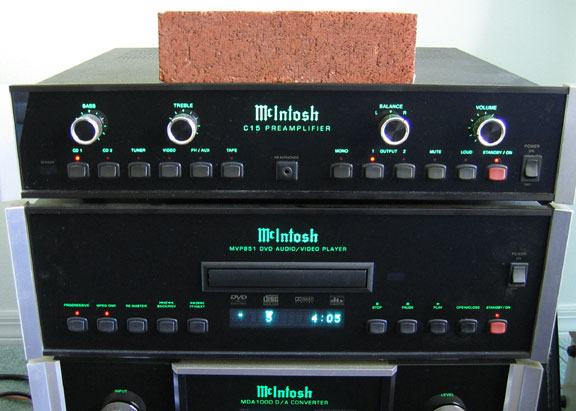
Rumors have been circulating in some advertising that placing an “audio brick” on the top of a power amplifier or preamplifier would make an improvement in the sound of your system. To test the truth of this claim, I set up a scientific experiment by placing a brick on a McIntosh C15 preamplifier and repeatedly took it from the top and put it back on. It should be noted that this is no ordinary brick but is a brick that is more than just a brick. It is a genuine McIntosh brick, acquired when the older brick front of the main plant was demolished in 2006. Now, if any brick is going to be effective, certainly a McIntosh brick that has been aged in harmony with thousands and thousands of amplifiers, preamplifiers, tuners, etc. would make a difference. It has been in synchronism with all of these products and now has a break-in period of over 50 years. It has been exposed to heat, cold, snow, rain and employees, as well as Frank McIntosh, Gordon Gow, Sidney Corderman, etc. Certainly this brick is tuned to maximum effectiveness if it is going to work at all.
The system was played at both high and low listening levels. The 1881 gram (4.17 lb) brick was heavy enough not to contribute any mechanical vibration during the test. The brick measures 8” wide, 2-1/4” high and 3-3/4” deep. After hours of listening both in daylight and in darkness I was not able to discern any differences whatsoever.
When I was in my teens, I used to be annoyed by the 15 kHz squeal of the horizontal output transformer in the old TV sets but no more. TVs have changed and so has my hearing. Ever had your hearing tested? When making speaker measurements using a microphone, a response curve of the microphone is needed to make any corrections due to microphone response variations. Otherwise you have a nice curve of the microphone and the speaker combined. Of course, some microphones have extremely flat response in the audio range such as those made by Bruel & Kjaer of Denmark and corrections due to the microphone response are not needed.
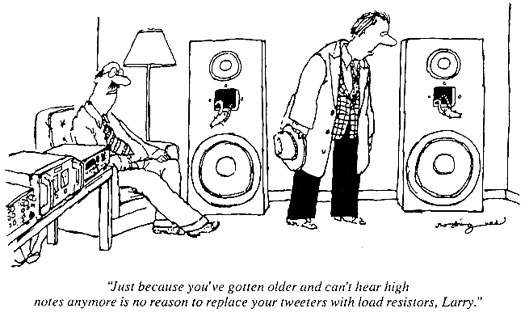
Courtesy of Rodrigues
What about hearing calibration? Hearing losses normally occur at the higher frequencies and become more pronounced as we get older. Then there are losses due to exposure to excessively loud sounds that can cause hearing damage and that seems to be very widespread today. It is understandable that some people with a high frequency loss might choose a speaker with exaggerated high frequencies to compensate for a high frequency loss. This is the forerunner to using a hearing aid that also compensates for hearing losses.
Is a small long excursion woofer the same as a large short excursion woofer? Suppose they both move the same volume of air. Will they sound the same at low frequencies? Probably not. Ever hear a system that has “effortless bass?’ What makes it so? It is those systems that have a large cone area and the larger the better in that respect. The drivers couple to more air and the excursion is relatively small.
In the case of the small driver wide-range column systems each driver might have only a 5mm peak-to-peak linear excursion. This is within the excursion range where the voice coil always has the same number of turns in the magnetic gap. The harder the woofer is driven beyond this range, the fewer turns remain in the gap. However, even if there are only a few less turns in the gap, distortion does not dramatically increase. The linearity follows an “S” shaped curve and distortion increases only gradually until it becomes audible. Eventually, no amount of driving force will cause further displacement. By then, the voice coil can be almost completely out of the gap. Now, if the driver is designed well, the limiting factor will be the voice coil and not the spider or surround and there must be room at the back plate so the voice coil does not hit the back plate and be damaged.
Do we really hear a change in low frequency distortion when the driver gets non-linear? Remember that music, even at low frequencies, contains harmonics. With only slight non-linearities, the music can mask the distortion generated by the woofer. Of course, eventually distortion will become audible. So as far as listening goes, the excursion for many different woofers can effectively be greater than the Xmax that is normally used in the specifications but depends on how well the driver is constructed.
When it comes to a column system like the IDS-25, twenty five 3-1/2” drivers having a peak-to-peak linear excursion of 5mm, can be equated to a single 12” woofer with a peak to peak linear excursion of 0.3” or perhaps a 10” woofer with a longer excursion. The effective excursion could be greater than this as described earlier. But the effective cone area of the column is closer to a 16” woofer and it is the larger area that is more important.
Then, there is the final and most significant advantage to the column. I measure a 10 dB increase in level from the lowest frequencies to the upper mid-range when compared to a single driver in the test box and in the same room, in the same location and at the same power input. Remember, the impedance of the column is the same as a single driver. This means that for a given power input to the column of 25 drivers, the acoustic output is 10 dB higher without any increase in power, driver excursion or distortion. Also, recall that the power to each driver is only 1/25th of the input power. When you consider that an amplifier with half the power (a 3dB decrease) comes at great financial savings, a 10dB decrease offers one tenth of the power needed for the same listening level .
What is a subwoofer anyway? It is a supplementary low frequency speaker that extends the low frequency response below what a typical speaker can do. Most speakers can go down to 50 Hz without much trouble, but sometimes not as low as 20 Hz and maintain an effective output. Not ALL speaker systems need a subwoofer, however. For instance, the McIntosh ML-1C and equalizer is a full range system that can go down to 20 Hz and requires no supplementary subwoofer.
The question here is do we need two subwoofers or one? We have been told by some people who are not burdened with knowledge: "Don't worry about 'stereo bass' --it doesn't exist in many recordings. Practically all of the low bass in a movie soundtrack is recorded in mono, and even if it weren't, low frequencies are mainly non-directional." Stereo Review January 1966 (See note 1)
The reply to my complaint is in Stereo Review April 1966 (see note 2). It is about the author's assumption that most bass is mono and therefore not important enough to warrant two subwoofers. He says: "With regard to phase, when I switched the stereo test signals into mono they sounded virtually the same. At these low frequencies the effects of the resonances and reverberation time of the listening room began to overpower the direct sound at the listening position, and there is insufficient "separation" of human ears at these frequencies for there to be large difference in the signal. Changing to mono can be plainly audible when very low frequency signals are heard through headphones but not in normal listening rooms"
Of course, I'm talking about audible differences in the same room playing the same recording and I can easily hear differences in deep bass in stereo compared to mono regardless of room effects. If I can hear them, I'm sure most people can hear them. Of course, there's all shades of gray where at other low frequencies phase differences have various degrees of being in or out of phase. This serves only to make things even more audible.
In AudioScene Canada, Andrew Marshall wrote: "If phase coherency is in, it doesn't seem to have occurred to many makers of subwoofers. Their solution has been to simply avoid the question by combining the channels below 100 Hz for the single subwoofer." (See note 3)
To go even further, at these frequencies we can even feel the sound waves as well as hear them. It depends, of course, on how the recordings are made. For example: some stereo recordings are made with two microphones at the same place, but pointing in different directions (coincident microphones) and there are no low frequency phase differences. Other recordings are made with microphones as much as 20 or 30 feet apart and there are significant low frequency phase differences.
In Audio, February 1994, John F. Sehring wrote about the advantages of Stereo Subwoofers "With out-of-phase signals, a mono subwoofer may give you less bass than no subwoofer at all." (See note 4)
In a good two or three microphone stereo recording, bass information can arrive at different times at each microphone. The arrival time at each microphone can be such that at some very low frequencies the sound is 180 degrees out of phase. If you combine these frequencies into mono, the result is zero output at those frequencies. This means if you have a 32 Hz organ pedal note that has a phase difference of 180 degrees between channels, you will get nothing and feel nothing, except perhaps hear a few harmonics. I think even a deaf person can feel the difference between a 32 Hz note being present or not!
But what if you play mono bass out of left and right subwoofers. Won't there be cancellation at certain deep bass frequencies? Yes, there can be but you would have to be sitting very close to only one of the subwoofers to get significant phase differences at the very low bass frequencies. There would need to be a path length difference from each subwoofer to your listening position of 8 feet at 70 Hz to get complete cancellation. At 32 Hz the difference in distance would need to be 17-1/2 feet. We normally sit at or near the center where the distances are almost equal. Room acoustics are then much more significant. Further, The subwoofers can be placed to the inside of the main speakers (closer to the center) to make the difference completely negligible and without deteriorating the deep bass stereo.
There are two ways to observe low frequency phase differences. Most McIntosh preamplifiers have a mode control that can be set to seven different positions including stereo and mono. By switching from stereo to mono sometimes a loss in deep bass can be heard, particularly if you turn up the loudness control. In that case phase cancellation of the program material is taking place. A single subwoofer is inadequate for that program material.
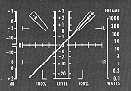 Another more scientific approach is to use a McIntosh
MPI4 or an oscilloscope to display Lissajous figures. An adjustable electronic
crossover having a rolloff of 24dB/octave and set to an 80Hz crossover
frequency can be connected between the preamp output and an MPI4 or
oscilloscope. This will eliminate much of the higher frequencies and make the
deep bass easier to see. For the MPI4, push the Stereo button. For the
oscilloscope, connect one stereo channel to the horizontal input and the other
channel to the vertical input. With the preamp in the mono mode adjust the MPI4
or oscilloscope gain to display a 45-degree straight line.
Another more scientific approach is to use a McIntosh
MPI4 or an oscilloscope to display Lissajous figures. An adjustable electronic
crossover having a rolloff of 24dB/octave and set to an 80Hz crossover
frequency can be connected between the preamp output and an MPI4 or
oscilloscope. This will eliminate much of the higher frequencies and make the
deep bass easier to see. For the MPI4, push the Stereo button. For the
oscilloscope, connect one stereo channel to the horizontal input and the other
channel to the vertical input. With the preamp in the mono mode adjust the MPI4
or oscilloscope gain to display a 45-degree straight line.
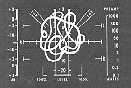 Switch the preamp to the stereo mode. Any phase
differences between channels will depart from a straight line and have a
circular motion. When deep bass is heard, a corresponding pattern may be seen.
If there are no phase differences, the pattern will remain a straight line.
Different recordings will show a different variety of displays.
Switch the preamp to the stereo mode. Any phase
differences between channels will depart from a straight line and have a
circular motion. When deep bass is heard, a corresponding pattern may be seen.
If there are no phase differences, the pattern will remain a straight line.
Different recordings will show a different variety of displays.
In my experience, deep bass does not occur very often, perhaps only 5% of the time, but when it is there it is most impressive and I don't want to miss it. If you are concerned about accuracy for all types of program material, and who knows how a recording has been mixed, two subwoofers should be used, one for each channel. How many of us use our home theater system to play our older stereo recordings as well as movies? Please raise your hand! Thank you. If you're using full range speakers on the left and right front channels and no mono subwoofer, you got it right!
Separate Source Perception
In addition to the problems of combining left and right channels into mono, some people maintain that deep bass is non-directional and therefore subwoofers can be located anywhere with respect to the main speakers. What constitutes a deep bass frequency? In truth, the crossover frequency determines if this can be heard or not. Suppose you have the main speaker and the subwoofer separated by two meters. Perception of the different locations of this wide-range sound source occurs when the distance between the speakers is greater than 1 meter. A paper presented some time ago at the Audio Engineering Society by General Electric shows that only a few people are able to consistently perceive separate sound sources as low as 70Hz. As the frequency increases, however, more people are able to tell the difference. By 150Hz most people can distinguish this. If a crossover frequency above 70 Hz is used for a subwoofer, stereo imaging accuracy can decrease because the image is smeared between the subwoofer and the main speaker which is also radiating the same frequency. Keep in mind that a 70 Hz crossover doesn't mean that the woofer output suddenly dies at 71 Hz. It can continue to radiate through 80 Hz or 90 Hz or even higher depending on how sharp the crossover rolls off the higher frequencies. In addition, if the woofer has a rising response or a peak above the crossover frequency, this also will influence what can be heard. When using higher crossover frequencies, each subwoofer should be kept less than one meter from the main speakers.
1. Audio Q & A Stereo Review
January 1996 page 32
2. Letters Stereo Review April 1996
3. The High End by Andrew Marshall AudioScene Canada November 1979 page
32
4. The Advantages of Stereo Subwoofers by John F. Sehring Audio February
1994 page 26
How Fast Is Your Audio System?
Many years ago, Harman-Kardon began emphasizing the importance of square wave response in audio electronics. Today, the term "square wave" is no longer being used but a more obscure term called "fast" is used. Capacitors, speakers and amplifiers, etc. are referred to as being fast or perhaps slow. The implication that something might be slow in today's world of faster computers would be undesirable. Fast computer processing time is, in fact, desirable. Audio system response and hearing requirements can be something entirely different.
A square waveform rises infinitely fast, holds at constant amplitude and then falls infinitely fast to an equal negative value, holds at constant amplitude and then rises infinitely fast to repeat over again. A square wave signal can be generated electronically and can cover a frequency range from of 20Hz to 20kHz or even wider. It can be applied to a preamplifier, power amplifier or other audio equipment and the resulting output observed on an oscilloscope.
Harmonic analysis of a square wave shows that it is made of an infinite array of odd order harmonics that decrease in amplitude. It consists of the fundamental frequency that has an amplitude of one. The 3rd harmonic has an amplitude of 1/3 of the fundamental. The 5th harmonic has an amplitude of 1/5th of the fundamental, etc. The fundamental and each of these harmonics can be thought of as a pure tone or what is called a sine wave. The lower harmonics are the most significant in contributing to the shape or "speed" of a square wave and the shape of the leading and falling edges. As the harmonics get even higher, they contribute less and less to the leading and trailing edges until they become negligible.
As a rule, the bandwidth of an amplifier that will reproduce a good looking square wave must extend from 1/10th of the fundamental frequency of a test square wave to 10 times its frequency. For example, if an amplifier passes a 2000 Hz square wave without distortion, the amplifier should have flat response and be free from phase shift or oscillation from at least 200 to 20,000 Hz. But what if a 20kHz square wave is applied? Should the amplifier output also be a square wave? The fundamental is 20kHz, third harmonic is 60kHz and the 5th harmonic is 100kHz.. Tests indicate that we don't hear pure tones beyond 20kHz.
So why do companies make amplifiers that go beyond 20kHz? When feedback was introduced in audio amplifier design, one of the benefits was a broader frequency response along with reduced gain and lower distortion. Extended bandwidth to 100kHz or 200kHz was inherent with the application of feedback. This was for free, so to speak, and provided an advertising advantage of greater accuracy.
However, Gordon Gow at McIntosh pointed out that acoustic square waves do not exist in nature. Even if they did exist, he claimed that they could not propagate through air, which is a differentiating medium. At one time we investigated what we thought to be some things like a pistol shot, wooden block and spark gap. A 1/4" Bruel & Kjaer 4135 microphone having response to 100kHz was used along with a Tektronix storage oscilloscope to display the rise time. Perhaps the most promising was striking two small pins together directly in front of the microphone. Fast rise times shorter than 12 microseconds just weren't there. That's the rise time of a 20kHz pure tone or sine wave and represents 1/4 of the wavelength at that frequency.
Despite the logic of sine wave analysis that is used to describe square waves, is this how we hear? Other opinions shed a different light. Back in 1961, science fiction editor and author John W. Campbell, Jr. wrote an article titled “Sineward” Distortion in High-Fidelity Amplifiers, Audio magazine, November 1961, Pages 52-58, 90. He concluded that the ear is not a spectrum analyzer but is a waveform analyzer such as that displayed on an oscilloscope. The example of the amplifier in the article demonstrated that an amplifier that has a bandwidth to only 20kHz does not sound as good as an amplifier that has extended bandwidth to perhaps 80kHz or more. The reason is that the ear can detect waveshape transients that require extended bandwidth even though we cannot hear sine waves beyond 20kHz.
When it comes to woofers, the term “fast” can be misleading. As in the electronics, to fulfill the "fast" requirement, a woofer must have a wide bandwidth, yet woofers are designed intentionally to have only a narrow bandwidth so that a smaller mid-range or tweeter can better radiate and disperse the higher frequencies. A "fast" woofer is therefore undesirable because it will radiate into the mid and high frequency bands and cause interference. The result is uneven response and directional peaks and dips.
Truly fast drivers can cover the entire frequency range. They can be found in headphones but when it comes to speaker systems, a truly full-range driver is rare. One exception was a single driver horn system designed by Paul Voigt that covered a very wide range. Similar single full-range drivers are now sold by Lowther in the UK and a few other companies. Another exception is my own IDS-25 column system using 25 full-range drivers that all cover the whole frequency range.
Loudspeaker Advertising 1930
Allied Radio Corporation, 711 W.
Lake Street, Chicago, ILL.
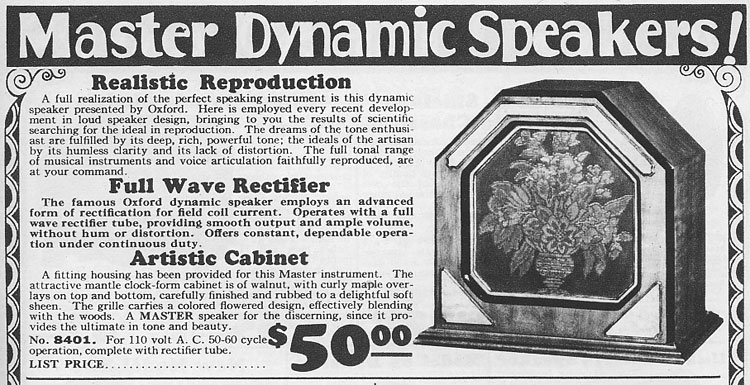
Words such as "perfect, ideal, scientific, powerful, clarity, lack of distortion and full tonal range...faithfully reproduced" are used to describe the above speaker. Such a play on words and meanings to sell a speaker can just as well apply today. This speaker could be a new product just introduced and advertised in the audio magazines.
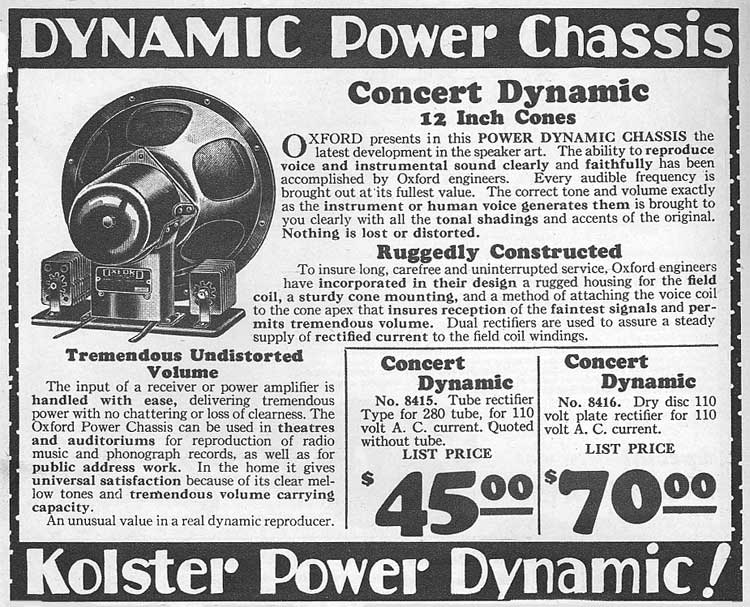
The early speakers did not use permanent magnets. They used a specially wound copper field coil that energized the steel structure. The amount of current in the coil determined the strength of the magnetic field in the voice coil gap. This, in turn, controlled the efficiency and magnetic damping characteristics. An overdamped condition using high current had high efficiency but relatively little deep bass. A critically damped speaker had moderate bass and efficiency and an underdamped speaker using minimal current had greater relative bass but lower efficiency in the upper bass. Although these options were available to the designers, it is likely that higher efficiency was chosen most of the time.
It was common in radio receivers to use the field coil as a filter choke to reduce ripple in the DC voltage supply to the tubes. In stand-alone speakers, a rectifier tube was needed to provide DC for the coil but later dry-disc rectifiers were used. The power was supplied by 110VAC wall outlets
Truth and Superstition in Audio
I'm sure that pages and pages of words can be added to the above examples. The point of these ads is that it is easy to make up all kinds of claims and if no one can prove they're wrong, then they must be true. This kind of reasoning is faulty and is again Aristotelian in nature.
In formal logic it is the burden of the person making the claims to prove they are true. How many times have you bought a new component that has been praised up and down with words glorifying the appearance and performance only to find it isn't as good as you were led to believe by reviews and advertising? Perhaps this attraction is based on appeals to tradition, authority or just plain blind faith.
It is common practice when reporting on a particular subject to first gather related facts about the subject. The next step can be to edit and select only the facts that support the point that is being made and ignore the rest. This goes for advertising, news writing and many other categories. For the experienced reader who is knowledgeable on the subject, the missing information will be noticed. For others who have no direct knowledge, the limited facts can create an entirely different story, sometimes in direct opposition to what would have been created if all the facts were mentioned.
This narrow tunnel vision is not unusual. We tend to see and hear only what we want to see and hear particularly when it supports our own opinion. A person's opinion can be different at different times, in the same way that what they see and hear is different at different times.
Superstition isn't just for those who believe in ghosts, flying saucers, faked moon landings and that the earth is flat. It has also invaded audio. This is particularly true for those who don't understand scientific thinking. The truth for some people has become a fad that rejects science and reason. It is a waste of time trying to convert the dedicated believers, but others may be willing to listen.
The opposition to facts reminds me of a story where a research team came to investigate some mysterious lights that were seen at night by people in a certain area. They were opposed to the objective findings of a science team saying that they didn't want to know the cause of the lights. They preferred the mystery and to think that the lights might be from alien spacecraft.
Here are some claims that are opinions and not facts.
Tubes sound better than solid state.
Expensive speaker wire is better than inexpensive speaker wire.
Digital watches interfere with CD players.
Green markers applied to the perimeter of CD's make them sound better.
There are some things that can't be measured that make the difference.
A special audio brick placed on or near your amplifier improves the sound.
Hookup wires are directional.
For Those Who prefer Occult Explanations
You scientists have missed the whole explanation and have a completely wrong approach to putting down some people who can correctly identify different speaker wire or different amplifiers, etc. in blind listening tests. This does not involve hearing at all. It involves mental projection known as Remote Viewing. By concentrating on which unknown component is being tested the “listener” can assume identity with the circuit that is activated and therefore easily pick the correct one.
Others may use out-of-body experience and are able to witness how the switch devices are set. However, the most common and perhaps scientific means may be found in those who have vestigial Ampullae of Lorenzini. A pair of these unique organs allows the subject to detect the location and distance of minute electric fields. This way they can tell which component is in use. Science fiction? Not at all. These organs can be found in the shark and the duck-billed platypus to locate prey in exactly this manner. The only fictional part is that it is latent in humans as far as I know.
Then there are those who may have sensitivity to magnetic fields as found in the spiny lobster and the homing pigeon. Magnetic flux, as small as the earth’s magnetic field can be easily sensed. Similarly, current flowing in the wires of the equipment being tested generates a magnetic field that can be detected with a pair of such organs and the components can be located.
Yet even more bizarre is that information could be delivered via telepathy from aliens in flying saucers or by deceased relatives that are hanging around to whisper in your ear. Of course, if you have received an implant during your alien abduction, this could account for exceptional powers that would certainly astound the rest of us earth people. Even an addendum to the works of Nostrodamus could allow you to foresee the correct identity of each component even before making the listening tests. It is best not to reveal the results before the tests are completed.
To some believers, all of these abilities might seem to offer 100% accuracy. Of course, a complicating factor influencing the test results is that the subjects may not want reveal their extra sensory proficiency and may deliberately report some erroneous choices to throw the examiners off a little about their unfailing talent. Otherwise, it might be government intervention and confinement for study in a remote laboratory. After that, you never existed!
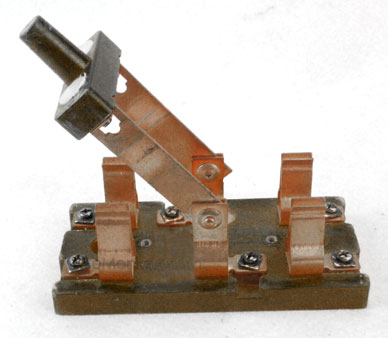
How about an industrial grade power switch? This kind of knife switch may be how the main power to your building is turned off or on. Knife switches are also used by the power company to turn off the power at the power pole when repairing power lines. Why trust those dinky little contacts in your equipment to handle those turn-on transients and surges in your system. Here is a more reliable never-fail master power controller that has a large conducting area of pure copper. (silver plated contacts are optional). You are in control of how and when your system is turned on. This heavy duty switch is conservatively rated at 380 volts and 100 amps. Magnetic arc suppressor kits are also available.
|
About This Site |
||
|
|
More text and pictures will be added as my research continues. Any contributions, comments, corrections, or additions are welcome. |
|
|
|
|
|